
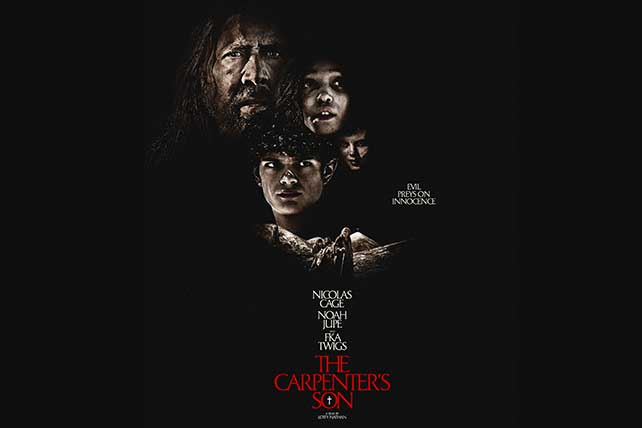
Writer-director Lotfy Nathan recently discussed with ChurchLeaders his bold new, sure-to-be controversial film “The Carpenter’s Son,” a biblical horror-thriller that explores the unrecorded childhood years of Jesus.
The film stars Nicolas Cage as The Carpenter, Noah Jupe as The Boy, FKA twigs as The Mother, and Isla Johnston as The Stranger. “The Carpenter’s Son” is rated R for strong/bloody violent content and brief nudity.
Nathan explained that the film is loosely inspired by the apocryphal Infancy Gospel of Thomas, a text he learned about growing up in a Coptic Christian household. While the text is not canonical, it sparked his imagination about Jesus’ younger years and the period when he would have been simply known as “the carpenter’s son.”
RELATED: Trailer Gives First Look at Nicolas Cage in Horror Film About the Childhood of Jesus
Nathan acknowledged that some Christians will object—either because the film humanizes Jesus with vulnerabilities or because it uses horror elements. But ultimately, Nathan hopes that audiences will give it a chance and allow the film provoke thoughtful reflection rather than controversy.
“I didn’t initially have a desire to make a faith-based film. It’s a big can of worms…there’s no getting it totally right as far as the whole religious audience is concerned,” Nathan told ChurchLeaders. “There’s a lot to uncover. But there was something about the idea that piqued my younger curiosity.”
Nathan shared what first sparked the idea to create the film. “Having the idea to do a film about the Holy Family and this sort of missing piece of the puzzle of the timeline came from learning about the apocryphal gospels,” he said. “So I was introduced to that by my dad, who’s big on old religious texts, you know, just from a curiosity standpoint. He showed me that, and I had never heard about the apocryphal gospels either.”
He continued:
Of course with that said, the Infancy Gospel of Thomas itself is pretty brutal, and I can understand actually why when people first hear that it’s a loose adaptation of that, that would trigger some, right? Because if you were to do a one-to-one adaptation of that text, it’s pretty harsh. There’s a reason it didn’t make the canon. At the same time, my family’s Coptic Orthodox Christian…they hold those texts as a piece of interest. It’s refuted and it’s not part of the canon, but in the Coptic Museum in Cairo, for example, they have old editions of that text. Not that they believe in it, but it’s of interest. So this got me thinking. There’s this fine line where there’s speculation that I think everybody has.
“So yeah, it’s very loosely inspired by the apocryphal gospels,” Nathan explained. “But from there, it was really an effort to find what pieces could still fit in the timeline of the New Testament and the Jesus that people most widely understand by the end of the story.”


