
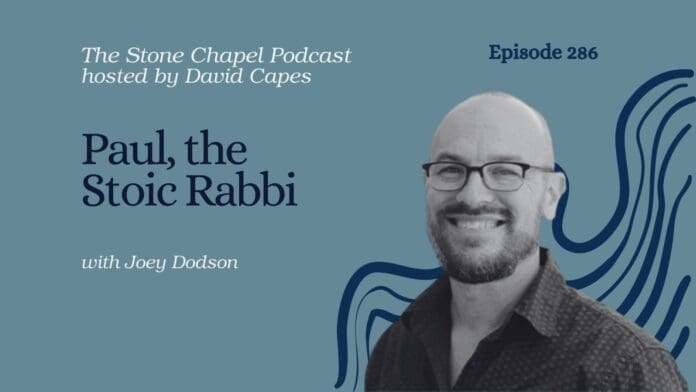
Joey Dodson
I suspect that Paul read the “Wisdom of Solomon,” like we might read C.S. Lewis today, or Tim Keller or David Capes if you were going to an ancient bookstore. If there were those in Barnabas and Nobles.
David Capes
Barnabas and Nobles, I love it!
Joey Dodson
Yes, it would be really popular. And I’m guessing whether it was Paul was under Gamaliel, or just as his own reading, because there wasn’t as many books during this time that Paul was familiar with the “Wisdom of Solomon.”
David Capes
These are Jewish books that are written at roughly at the time of Jesus and Paul and they give us a great deal of insight into the Jewish people. So it’s a great thing. Now, the second part of the book is about Paul the philosopher. Is that a technical term that you use that he is a philosopher?
Joey Dodson
I think most people would consider Paul a philosopher. He even teaches in a lecture hall. Philosopher more than a rabbi. Rabbi spoke predominantly to Jewish people. Here Paul is speaking to Gentiles. The philosophers taught both men and women like what we see Paul do, and they’re dealing with some of the same issues. Now, often we think the word philosopher. We think of our philosophy class that we had in the university. Philosophers during this time, predominantly were about moral formation. How do we get rid of those sinful desires and live a life that imitates God and so much of what Paul presents? And this is how the philosophers, when they see Paul, they think he’s an amateur philosopher. He’s
very good he’s a sperma-logos. You know, an armchair philosopher, or theologian. But then he begins to speak, and they realize, wow, he’s actually out Socrates’s, Socrates there in Acts, chapter 17 I think for many people. Because Paul is not connected to a cult, because he’s not always even quoting the Hebrew Bible, like what we see in 1 Thessalonians, even though I think that’s under the surface. Paul even quotes some of their poets. In 1 Corinthians 15, Paul, in the same breath, it’s just seamless, goes from Isaiah to Meander, this ancient poet. And so “eat, drink and be merry” and “bad company corrupts good morals”. And so you have Paul drawing upon both of those. And for many people, they
would see Paul as a philosopher.
David Capes
How would you understand inspiration? At that point, people say it’s inspired by God, but he’s quoting this pagan philosopher. How does inspiration work for you?
Joey Dodson
Theopneustos. This word inspiration, we often use it in conversations for inerrancy of Scripture, but theopneustos means “that which is coming from the Lord”. One thing that philosophers would say is that all truth is God’s truth. And if Plato stumbles upon a truth, it’s not his truth. This is God’s truth that’s inside of them. When Paul is speaking to the Gentiles, at one point, he says, “you know, God did not leave you without a witness”. Later on, he’ll say, “even as your own poet said”. I believe that just as God uses Moses and the Torah and the prophets, and the Hebrew Scriptures. So also to reach the Gentiles, he’s going to draw on these great quotes that give us a picture of even the Gentiles being in
the image of God. God is so providential that just as he’s going to use Moses, he’s also going to use the likes of Seneca to draw people in and it’s effective in Athens. Some there are philosophers that become Christ followers.
David Capes
Right, exactly. And he certainly planted some great seeds there. There are people that look at the world as if God was only at work in the Jews and Jewish people, at that time. Like he had never really worked among Gentiles. Mark Lanier makes a great case, I think, for the idea that God is and has been at work in these places as well. Not to the same degree, or to the full flourish that we see in Christianity. But still, God is working. When Paul quotes the philosopher or poet, it could well be that what he has quoted really does, represents the truth, and it represents that which God has breathed into these other folks as well.
Joey Dodson
And I think it shows Paul’s evangelistic heart. Even today. I could say God placed eternity in our heart and be more hyper spiritual, quoting Augustine. Or I could say, “I can’t get no satisfaction, but I tried, but I tried, but I tried.” I could go with Rolling Stones, or I could go with Augustine. With both of those the heart is to say that we can only find full joy and eudaimonia, flourishing in Jesus Christ.
David Capes
Seneca is your conversation partner here. Why Seneca among others?
Joey Dodson
I love me some Seneca! Seneca was the most prolific Roman stoic, philosopher. He was one of the most popular among the elite during the first century, during Paul’s time. So often when people think of Stoics, they may think of Marcus Aurelius, the great stoic emperor, but he would be like the Taylor Swift of stoicism, like pop stoicism. He’s a great entryway. And I love his meditations. They might think of Epictetus, who is a little bit later, and who actually writes in Greek. And so it’s great to put Epictetus as Greek up against other and he writes in Koine Greek at that. But as far as the one who had the most influence, Seneca, would be that one, and he, again, was contemporaneous with Paul. He was born about the same time Jesus was born. He lived in Egypt, probably about the same time Jesus was in
Egypt.
He was born in Spain and comes to Rome. He wants to be a professional philosopher, but his dad encourages him to take a place in the Senate. He went into exile, similar to what we see with John in Revelation, under Claudius. When Claudius dies, the Jewish people are allowed to come back into Rome, if you remember this. And Seneca is able to come back as well.
He begins to tutor the next emperor, Nero, and ends up dying under Nero. So Nero executes Seneca also. And early church fathers even claim Seneca as their own. Our Father Seneca because he seemed to be at the threshold of Christianity without even realizing that he was. Hopefully the second part of the book will show that, to go back to that theopneustos word, that inspiration. I think the theopneustos should be translated as inspiration when we’re talking about our scripture, but maybe inspiring would be another way. And so Seneca is not inspired the same way that Romans is inspired. That Isaiah is inspired, but it is inspiring. And I’d say he’s saying the same thing as with “[Wisdom of]
Solomon.” It may not be inspired in the same way as Genesis or Deuteronomy, but it is inspiring to read.
David Capes
We would say the same thing about C.S. Lewis. Inspiring to read. And we could bring it into our sermons to help illustrate things. Obviously, they need to get your book, and they need to see how you have pulled together Seneca and Paul into this conversation. But if they just wanted to read something about Seneca, where would they get started? Where’s the best place to read in English?
Joey Dodson
They can probably Google it and get it for free. It’s public access. The translations are going to be different. If you get a public access, it’s probably going to be more like the King James Version. I’m guessing most of the people that listen to this podcast are more erudite, and so if they like languages, you can get the Loeb Classical Series, The LCL that’s going to have the English translation on the one side and the Latin on the other. And I think it’s probably one of the best translations.
Seneca wrote the letters very similar to Paul, and about the same length as Paul as well. And so when you think of those who wrote really, really, really long letters in the first century, Seneca and Paul wrote these moral essays, like on the providence of God and on mercy. John Barkley, for those of your audience who’ve mirror with him, thinks that Paul’s understanding of grace and gift aligns and accords and harmonizes more with Seneca than anyone else. Paul might say things like in Ephesians 5, “don’t let the sun go down on your anger”. But Seneca is going to have three books dedicated to how to overcome anger and what anger is. And so the moral essays would be that.
And then he also wrote dramas he had two blockbuster hits, if you will, on Hercules. One in which Nero actually played the part of Hercules during that time. And I’m not a literature person, but literature people say that Seneca’s plays actually influenced Shakespeare, and so it was almost proto-Shakespearean.
David Capes
Interesting. Well, it’s a great book. It’s a great idea for a book, and you’ve done well. I’ve got a digital copy here, but I always like to hold the copy. I love the cover. Hendrickson is publishing it.
Joey Dodson
Thank you! One of my former students is an acquisition editor, and like you, I have a hard time saying no to my former students. I prize them so much. This is somewhat of a summative work of my last 30 years studying Paul. And the first half is with “Wisdom of Solomon.” The second half is with Greco-Roman philosophy.
David Capes
The book is entitled Paul the Rabbi Philosopher: Stoic and Jewish Philosophy In the Apostles’ Thought. The author is Dr. Joseph R. Dodson. and Joey, thanks for being with us today on the podcast.
Joey Dodson
Thanks. All the best.
Transcribed by https://otter.ai
