
► Listen on Amazon
► Listen on Apple
► Listen on Spotify
► Listen on YouTube
You can find previous episodes of “The Stone Chapel Podcast” at Lanier Theological Library.
“The Stone Chapel Podcast” is part of the ChurchLeaders Podcast Network.
This episode has been edited for clarity and space.
Lyndon Drake
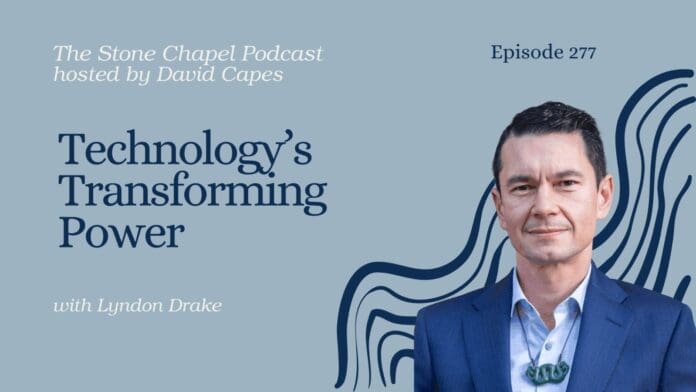
Hello, I’m the Rev. Dr. Lyndon Drake. I’m a research fellow at the University of Oxford.
David Capes
Dr. Lyndon Drake, or I should say, the Rev. Dr. Lyndon Drake. Thanks, Lyndon, for being with us today on “The Stone Chapel Podcast.”
Lyndon Drake
Thanks so much. It’s wonderful to be with you and with all your listeners.
David Capes
All right, you said the Reverend Doctor. Are you Anglican?
Lyndon Drake
I am an Anglican minister. I was in New Zealand, the Archdeacon of Tamaki Makaurau, which is the Maui name for Auckland City. And I was in Anglican middle management, which is probably the easiest way to think of it.
David Capes
In middle management! Now you’re in Oxford, and you’re doing some wonderful work, both in theology as well as artificial intelligence. We’ll be saying more about that. But for those who don’t know you, give us a little background about you, maybe family, profession, those kinds of things.
Lyndon Drake
Well, I’m the husband of one wife and the father of three children, which I believe is the correct way around to have those numbers. I grew up in New Zealand and spent my first years there in a wonderful Christian family. I moved across to England in the year 2000 initially to do software development work and work in finance. I worked in finance for about 10-12 years in London.
And while I was doing that, I did a PhD in artificial intelligence. And then I’ve had another 12-year block, more or less, where I’ve studied theology and been involved in Christian ministry. And just over a year ago, as a family, we moved back to England, back to Oxford. I now work doing research on AI and theology and other things within the University of Oxford.
David Capes
Okay, so from New Zealand to England, and you went in the year 2000 which was the Y2K year. Everybody was afraid the whole world was going to implode. Do you remember those times?
Lyndon Drake
I do remember that. And to my recollection, I don’t think the world ended, But, you know, there was definitely some real concern about this.
David Capes
There was. I heard a number of sermons in those days by Christian ministers who didn’t really understand, I don’t think, what was happening. And everybody was going crazy at that point. It’s funny.
Lyndon Drake
It was. I mean, there was probably, maybe a marginal risk, I guess, of some systems breaking down. I was pretty unconvinced the world was about to end. I think Christian pastors, on the whole probably ought to stay clear of some of the technical details. But as you say, people felt inspired. I think that’s a good thing.
David Capes
All right, you’re coming to Lanier Theological Library to do a panel discussion and a lecture for us on artificial intelligence, faith, the transforming power of technology. You’re going to be talking about the kinds of things that are happening both with AI and before AI. We wanted today to give everybody a little bit of a preview of what you’re going to be talking about. Let’s step right into it. What’s going to be the big idea of your talk on that night?
Lyndon Drake
I think what’s really grabbed people’s attention recently is chatbots, which uses large language models. And there’s the sense people have that these are doing some things that we thought were maybe unique to us as humans. But instead, I want to invite everyone into a wider conversation within Christian theology, where we’ve thought about what it means to be human, really, for quite a long time. And we’ve also thought theologically about the tools that we use, for a long time in some quite profound ways that are relevant to this.
Back in the Middle Ages, we didn’t have intelligent machines, but we did have very powerful machines that did things better than humans could. And so what we want to do, is to have a confidence that theology has something to add here that’s really optimistic about our role as co-creators with God within his world, and participators in what he’s doing. That says we can look constructively at AI tools, and we can think about them theologically in ways that mean we can also contribute towards building society. Building church life, to live as individual, free people as well, in a world where these tools are suddenly impinging on us in our sense of what we are.
David Capes
I was with a Catholic priest on a radio show recently. He’s in his 70s. Mid 70s. He said he is really working through what he thinks about human beings, human persons. In other words, the question of theological anthropology, which is one of the big terms being bantered about. Even though we’ve been thinking about this for quite a while. It sounds like that’s going to be a really important part of what you’re going to be talking about. Helping us grapple with the whole question of, what does it mean to be human and be a human person.
Lyndon Drake
That’s right, well, and it has caught people’s attention and in wider society, as well as within the church. There is a new AI Ethics Institute here at the University of Oxford, a secular ethics institute. And the tagline that they put outside the building that houses both that institute and the theology faculty was that question. What does it mean to be human?
I happen to actually think that we don’t really need any novel theological insights. We don’t need new theological insights, but we do need to engage with the breadth and depth of Christian theology on this. Actually, there are areas in the mid 20th century, for example, around disability theology that help us to find the right art of Christian theology with which to answer that question. The reason I mentioned disability theology is that a number of theologians have pointed out that an account of being human or being image bearers of God, if that’s located in our competency and our capacity, seems to devalue those who have disabilities. That seems not an ideal situation.
There’s another strand of theological anthropology that emphasizes that our dignity and our worth comes because God confers that on us in his free choice. And he says, you are humans and you are image bearers. Because God says that we are and that gives us a different way of appreciating and thinking about our worth. So being in that conversation, I think, is really important. But as I say, all I think we’re doing there is surfacing the old debate. I think there are other areas where we need to really do some new work.
