
David Capes
It’s like the way Mark wrote it, not verse by verse, but the whole thing.
Karl Johnson
Right, exactly! It’s almost like this ancient monastic practice that’s getting reincorporated into the modern secular universities, with food trucks.
David Capes
I love it. That’s exciting. You’re heading off to Singapore. Is this becoming an international thing, or is it mainly North America? What’s the geographic?
Karl Johnson
Yes, I am. It’s mainly North America. I get a fair number of calls and inquiries from folks in other countries, and there are a few fledgling Christian study centers in other countries that are modeled after what they see happening here in North America. There are challenges to getting these centers established in other countries. One aspect of that is financial, and then there’s also just networking kinds of challenges. But there’s a lot of interest out there.
I’m going to spend an entire week in Singapore, and the purpose of the visit is three-fold. There’s a lot of Christian families in a place like Singapore who are sending their children to the United States for higher education. They’re asking the same kinds of questions that you were asking earlier. What happens if I send my kids to these institutions? What are the opportunities there? How concerned should I be? I’m going over to let them know what the landscape looks like here and what the opportunities are.
But then the other part of it is to let them know more about this model and to let them figure out what if any implications it may have for their local context. For example, in Germany, there’s now several of these small Christian study centers. And one of the reasons is precisely that the theological seminaries are not flourishing. As they shrink and die, the Christians who are there are very concerned about what is the future of Christian education in our country? And where can we provide theological training for future pastors as well as lay persons? And so the question arises, well, where are the students? And in
almost every country these days, the answer is, they’re at the state funded universities. That’s where the overwhelming number of students are, and so it makes sense for Christian organizations to essentially set up camp where the students already are and to provide some education and training opportunities right there.
David Capes
So a freshman student arrives on campus in the fall. How does he find you?
Karl Johnson
Well, these days, if they’re looking, it’s not hard. With all the online searches, an awful lot of the students will find these centers before they arrive.
David Capes
So they already know it exists.
Karl Johnson
Exactly. It’s not that hard. Many of the centers also run a 24- or 48-hour pre-orientation retreat, so that students can actually arrive a day or two early. They might be in a group with anywhere from a couple dozen or even more than 100 other students that they can get to know so they have some semblance of Christian community with other students in their class before orientation kicks in. But we can also mix in some upper-classmen Christian students to provide them with a little bit of here’s how life works at this university. We bring in a couple of Christian faculty members to give some brief talks. Yes, there are Christians here on the faculty, even though we don’t always speak in a Christian voice. So you might not know that, but yes, we’re here. We bring in a few pastors to give some short talks, to let them know about their local churches, and extend an invitation to join them for Sunday worship. And so by the time orientation begins, the incoming students have met other fellow first-year students, upper-class Christian students, Christian faculty members and local pastors.
David Capes
That’s a great strategy. This is bound to cost a lot of money. I’m thinking about the buildings right next to a place like University of Virginia or Cornell. How is all this funded?
Karl Johnson
Mostly from alumni, parents secondly, and there’s occasionally, a few foundation grants that will help with a particular project, here and there. But it’s individual donors, mostly alumni and parents. And it’s not impossible to kick things off in a very bootstrapped kind of a way. That’s certainly the way I did things, back in the day. And we would just have faculty members and parents doing talks on faith and vocation, and I would interview them, and students would come out and listen. You do what you can with the resources that you have.
But yes, it’s true, especially once you get into buildings, it requires a lot more resources, millions of dollars, to be sure. One of the reasons, among others, that I’m enthusiastic and even bullish on this movement is precisely because there’s a business model that works pretty well. One aspect of that is that, depending on the building you have, the buildings themselves can generate revenue. The ministry that I started, we purchased two large Greek houses that each have about 20 residents, so now we have 40 residents paying rent to the ministry. And we purchased the building outright with money that was donated. And we don’t pay tax, because we’re a non-profit organization, so we’re not paying property tax.
So all of that revenue is funding ministry staff who are ministering to the student residents. You know, it’s what I tell the donors. It’s like a double return on investment. Because if you put all that money in an endowment account, you put a million dollars in an endowment account. You might get $80,000 a year, or something like that. Now we get that much money in rent for every million dollars of equity in the house, and that rent is going directly to support the staff who are serving the students who are living in the asset. It’s really a remarkable model. And then some of the centers have commercial real estate. In Florida, there’s this very, very well built out coffee house, Pascal’s Coffee House as part of the Center at the University of Florida in Gainesville. Up in Minnesota, Anselm house, they’ve purchased a building that has 70,000 square feet, and the majority of it is rented out to commercial organizations that are paying rent supporting the ministry. So there’s all kinds of opportunities here, I think, even on the building front, for the ministries to become sustainable as a byproduct of getting into real estate.
David Capes
That’s an exciting kind of project that you’re helping to lead right now. You estimate that there are about three dozen centers. Do you see that growing?
Karl Johnson
Absolutely. I get more inquiries all the time. In the month of December, I think I received about 10 inquiries through our website from people saying, I would like to start a study center on such and such a campus. I received another one yesterday. I mean, these things are coming in as fast, almost faster than we can respond to them. It’s really incredible. But there are very healthy startup efforts at UCLA, in particular right now. It’s one that I’m watching. We have inquiries from some other well-known universities, and then there are some other universities that are not as well known. But that’s one of the signs of the spread of the movement, is it’s not just the campuses with 1000s of students and big
resources and big recognizable names. Sometimes I get inquiries from institutions, and I have to look them up to see where they are. I’m not familiar with them, but you know, the persons inquiring have been exposed to the movement at one of the larger campuses.
David Capes
I think parents who hear this, grandparents who hear this, might be encouraged and not so discouraged from sending their sons and daughters, grandsons, granddaughters, off to a well-known university because they know that they can find Christian community, Christian Fellowship, Christian teaching, and maybe even almost like a liberal arts degree in Christian theology there. This is a great movement’
Karl Johnson
I’ll say, for the record, I want it to be known. I’m a huge fan of Christian colleges. My wife, Julie, and I have five children, we sent three of them to Christian colleges and two of them to secular universities. When people ask me, what’s the better route to go, my answer is, there is no one right answer. It depends on the child, their interests and the opportunities that are before them.
We’ve had students come to some of the universities where we have centers, and they said, well, actually, my first choice was a Christian college, but I got so much more financial aid here that I didn’t really have a choice. I had to come here. But now that I’m here, I’m happy that I’m here, because I didn’t know there were all these opportunities for Christian learning here. But the bottom line, reality is that approximately 80% of students from Christian homes and families attend secular universities. That’s just the way the numbers work, and so I think it’s important in the broadest sense of church strategy. If we want to serve the next generation, we need to be thinking about, what are we doing for the Christian students at secular universities. And of course, it’s not just the Christian students. I mean, we’re doing a lot of public events as well.
David Capes
Some non-Christian students become Christians. I’ve talked to so many people who became Christians in college.
Karl Johnson
Absolutely, it’s a very incredible time.
David Capes
And a lot of that has to do with movements like the Christian Studies Center Movement.
Karl Johnson
Yes, absolutely.
David Capes
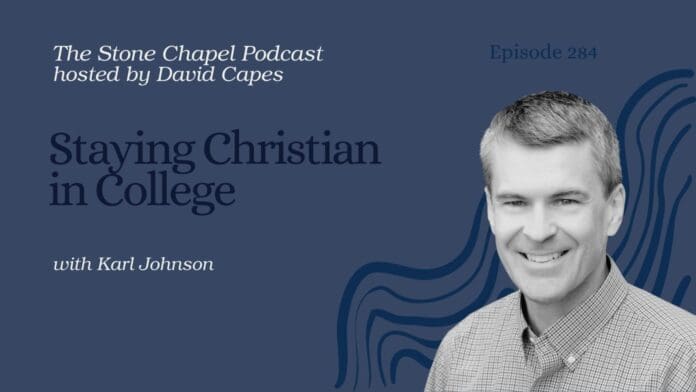
Karl Johnson, thanks for being with us today on “The Stone Chapel Podcast.”
Karl Johnson
Thank you, David.
Transcribed by https://otter.ai
