
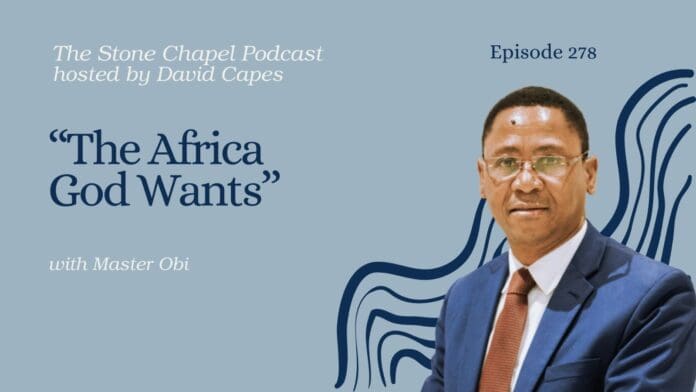
David Capes
Talk about leadership of churches in Africa. Are there enough pastors and church leaders in Africa and church?
Master Obi
We don’t have enough church leaders in Africa. I can tell you, the church in Africa is growing exponentially, and the growth outnumbers the pastors. We have a lot of those that are genuinely called to the pastoral work but are not trained. So training is a need that is a challenge. We have serious growth, and very few trained leaders to match the growth.
We will not be able to do that with formal education only. We need to now be intentional with non-formal theological education, and that’s something that we are taking seriously. We have quickly put together a curriculum, a non-formal theological education curriculum. There are some organizations in the continent who are also doing non-formal theological education, but even that needs to be a bit organized in terms of standards. So, you have all these people doing the non-formal theological education which does not have standardized, verified curricula.
We have an accrediting body as AEA. Now this is the body that does accreditation of theological education in Africa. For many years, this body only had formal theological education standards, but now I have tasked them to develop a non-formal theological education curriculum standard. Anybody else in Africa who is providing non-formal theological education can subject their curriculum to those standards, and then we can move towards standardized curriculum in Africa.
David Capes
That will just raise the quality of the thinking and the theologizing and the preaching and the teaching on the continent altogether,
Master Obi
Precisely, in order to match the growth.
David Capes
What’s interesting to me, Master Obi is the fact that we have more schools here in the United States, but fewer students. We have more seminaries and more schools that could give a very formal theological education, but those schools are shrinking. But over in Africa, you need more schools. You need more teachers. You need more people. People who are raised up within the African context, who can teach within that context, teaching the languages, teaching the cultures, teach against that, and show how the gospel really fits and works in Africa.
Master Obi
That is very, very true. It would be great if we can transplant some of these seminaries and put them around intentionally. This one in the east, this one in the west, so that we can meet the need! But having said that, it is true. I tell my people that we need a curriculum that is contextualized for Africa, that meets the needs of Africa. Because African church leaders are dealing with people who have a background of witchcraft. They are dealing with people with a background of religious extremism. You are dealing with a continent of people that have an environment that is infested with corruption and so
on and so on. We need a curriculum that is tailor made to produce a leader equipped to handle people like this.
David Capes
Because they’re going to encounter people like this?
Master Obi
Yes, so that we can then also transform Africa. As AEA, we have a long-term vision: the Africa that God wants. For us to achieve that we need leaders who are trained to transform Africa.
David Capes
And if you were to tell our listeners one thing they need to do to pray for Africa, what would that be?
Master Obi
The church in Africa is growing. It should continue to grow. One thing that we need to pray for is, in as much as there is horizontal growth, we also need the vertical growth. The deep-rooted Christian faith and also a faith that is connected to heaven. So, we need to pray for numerical growth, as well as quality growth. Secondly, we need to pray for persecution. Christians in Africa, in a number of countries, are going through horrible persecution.
David Capes
Yes, we hear about that on a weekly basis.
Master Obi
We need to pray for the brothers and sisters who are going through those persecutions. We need to pray for our brothers and sisters under repressive regimes. There are countries where my brothers and your brothers are in hiding. In order for me to meet them, I go through a third person. I talk to this person, and then he will talk to one person, who will then talk to them to say the Secretary General wants to meet you. They will pick a date, they will have to go to a place which is safe, and then they can make a video call. It’s so emotional, and in most cases, they go with pseudo names, and I have to
protect them. I can’t even put their names on the website, because once they are exposed, they go to jail and they disappear for forever.
David Capes
Boko Haram seems to be one of these groups who is not officially part of the government, but they’re still persecuting. You do have governments who are oppressive and would want to jail Christian brothers and sisters.
Master Obi
We have governments which are repressive. You talk of Eritrea, and it’s not a secret, and they should know, if they hear my voice, that we know our brothers and sisters are persecuted and do not have the freedom of worship. Our brothers and sisters are hiding. They have been killed. They are refugees in neighboring countries. So, it’s not just the jihadist, it’s repressive regimes such as those. And then you have jihadists around the Sahel. Sometimes the jihadists take advantage of weak states. When the government is weak, that’s an opportune space for extremists. They find Christians worshiping. They
kill as many as possible so that particular church will close. This is reality. This is happening, and these are Christians like you and me, killed for what they believe, Jesus Christ.
This is the reality of Africa. So when you pray for the Christians in Africa, the persecuted church, they should know it’s real. We need resilience. Northern Africa was Christian. But no more, and that’s what they want, to displace Christians in as many places as possible. They are trying to break the Sahel line, and that’s a highly contested line now, of course. Now there’s sporadic extremism, even down south in the southern part of Africa, in Mozambique, Cabo Delgaldo. Already we put together an awareness summit, and I brought people from the Cabo Delgado just to tell their story. And it was horrible what
they were telling us. In one example, a pastor is beheaded right in front of his wife. As that was not enough, the wife is carrying a child in her arms. The child was taken from the mother and chocked in front of the mother. The child was then cooked and the mother was told to eat her child. This is more than barbarism. This is more than inhumanity. This is evil. And this is not something that happened in the 18th century, in the 19th century. It is now.
David Capes
It’s happening now. It’s happening in the world of AI and in the world of the internet.
Master Obi
I’ve been to Niger, I have met my brothers and sisters of the capital, because they were given an ultimatum to denounce Christ, or on the following day, we are coming for you and your family, And the only thing these Christians could do was to run. I visited where they are living in plastic shelters. And these were decent people who had homes and families, but they had to flee to these inhuman shelters because of their faith. And it’s not only in those countries that I mentioned. In the Central African Republic, there is a displaced Christian community. I was in the Democratic Republic of Congo, eastern region, and we do what we can with what we have. Sometimes we feel that we are doing nothing.
I went into this makeshift rehabilitation center for child soldiers. My eyes can’t leave this little boy in front of me. I’m addressing them, you know, giving them encouragement, and motivation. We are teaching them upholstery to give them alternative skills so that they can have a way of living without a gun in their hand. My eyes cannot leave this boy, and I’m told he was a child soldier for seven years. And I’m trying to figure out how young he was when he began to be a child soldier. I broke. I literally broke. I held that boy in my left hand as I was speaking to his peers and others. I couldn’t leave him. I loved him, and I believe that was the love of God. I had $50 in my pocket. I took that $50 and put it in
the hand of this boy. I didn’t know what else to do. This is the heart of God, the God that you and I serve. This is how God feels about these brothers and sisters going through difficult situations.
Because this was just a makeshift upholstery rehabilitation facility, where we are trying to give them this equipment and it’s not up to standard, but it’s what we could give. And the following year, when the war was raging, and the rivals were closing in on Goma, the influx of women and children was just overwhelming. The General Secretary of our national alliance in the Democratic Republic had to take a bus that time. I was in neighboring Rwanda. In the morning, I had a knock on my door. When I opened, it’s a man and five others, And he says, Dr Master, we need help. The premises of the Alliance are filled with human beings. My own house is filled. We don’t have any more space. We need help. Give a voice on our behalf.
Fortunately, from nowhere, I had a thought of Barnabas. When I called, they were very kind. What can we do? I said, let’s build a school so that these children can continue their lives when they find themselves with nowhere to go. They sent for $48,000 and we were able to put together a facility for these children. And we were able to also buy sewing machines for the women because they have lost their source of livelihoods. We bought 100 sewing machines for these women to train on how to sew so that they can sell what they make, and have a source of living. You know, just humanity, being human. So these are some of my experiences on the ground, and they don’t end there. There are many
examples of what is happening in Africa.
David Capes
Well, the next time you come back to the Lanier Theological Library, we’re going to want to hear about more of these stories. Because they’re fascinating, they’re heartbreaking, but they will cause us, I think, to pray. To pray for you as the leader, but also to pray for all those who are facing the kinds of struggles that you’ve described today. Dr, Master Obi. Thank you for being with us today on “The Stone Chapel Podcast.”
Master Obi
Thank you. Thank you for having me and thanks to our listeners.
Transcribed by https://otter.ai
