
► Listen on Amazon
► Listen on Apple
► Listen on Spotify
► Listen on YouTube
You can find previous episodes of “The Stone Chapel Podcast” at Lanier Theological Library.
“The Stone Chapel Podcast” is part of the ChurchLeaders Podcast Network.
This episode has been edited for clarity and space.
Nicole Martin
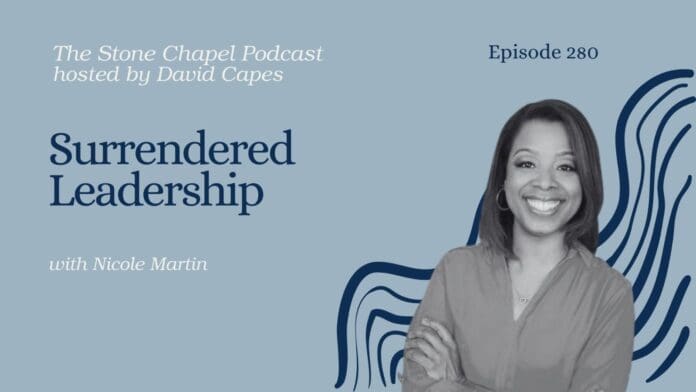
Hi, I’m Nicole Martin, and I’m the President and CEO of Christianity Today.
David Capes
Nicole Martin, Nicole, great to see you. Welcome to “The Stone Chapel Podcast.”
Nicole Martin
Thank you, David. It’s great to be on with you.
David Capes
I’m delighted that we can do this. You’re going to be coming here to the Lanier Theological Library and giving a lecture in a few weeks. We want people to know a little bit about you and a little bit about what you’re going to be talking about. And some will be able to get here in person, but for those who can’t, they can find your lecture on the library’s YouTube channel. All right, let’s start in this way. We know now that you are the president of Christianity Today. Congratulations, by the way.
Nicole Martin
Thank you.
David Capes
We’re so pleased for you and for the publication, it’s brand and all that it means. But for those who don’t know you, who is Nicole Martin?
Nicole Martin
Oh, that’s such a big question. I am first and foremost, a child of God. I’m a child of Pastor Leonard Massey. My dad was a pastor for many years, and Dr. Alfreda Massey, who worked in school systems and as superintendent for many years. I’m the mom of Addison and Josephine Martin. Addie is 13. Josie will be 11 by the time we come together. My husband Mark and I have been married for 15 years. I live in Maryland, and currently serve at Christianity Today, located in Wheaton. It has been an honor and a joy to be able to assume this position at this time.
David Capes
It’s a great publication with a great history that started back in the 1950s. It’s almost as old as I am, I think. Billy Graham was a big part of that, and such a great influence. It has been led well over the years. Christianity in general, and Christianity in the United States, has been through a lot since the 1950s. Christianity Today has been there as a guide and as a friend for so many. The only thing wrong with Christianity Today is, I don’t think you’ve ever published anything that I’ve written. We’ve got to correct that!
Nicole Martin
We must correct that, yes!
David Capes
All right, you’re coming to the Lanier Theological Library, and you’re going to be here February 27 and 28, 2026. You’re going to be lecturing in our stone chapel with a lecture entitled “Surrendered Leadership”, which is a fascinating title. I’ve got your books here. You have several books out, and this one is called “Nailing It: Why Successful Leadership Demands Suffering and Surrender.” I think you’re probably going to be talking about some things that you wrote here. Another great book of yours which is fairly recent is, “Made to Lead: Empowering Women for Ministry.”
So you’ve been writing about leadership for a while. Let’s talk a little bit about what are you going to be doing when you come here to the Lanier Theological Library?
Nicole Martin
One of the things that we will do together is to really redefine what leadership looks like from a biblical lens. It’s so easy for us to get caught up in more secular principles of what people think it means to lead. The world would suggest that in order to lead, you need power. In order to lead, you need deep influence. In order to lead, you need to be willing to stand up against the people that you lead at times. And while that may be true in some respects and contexts, it is not always the only narrative or definition for leadership according to Scripture. What we have seen over the years is we’ve assumed that we can have the resurrection victory of our lives and of our leadership without understanding the
cost of the cross.
And I would suggest that we lead best when we recognize that crucifixion always comes with reward and that resurrection always comes at a cost. There are some things that we will have to crucify in ourselves, in our lives, in our behaviors, in our patterns, in order for Christ to be resurrected. To be alive and well within us. In order for us to walk in that victory, whether we like it or not, and I wish there were another way, but biblically speaking, you cannot walk in victory without recognizing what needs to be surrendered. So that’s why this title is so challenging to each of us, because you cannot live a life with Christ without being willing to sacrifice and surrender things so that Christ might be redeemed, resurrected and glorified through us.
David Capes
You’re finding this in the words of Scripture. And in the example of Christ as well.
Nicole Martin
Yes, absolutely. And Jesus is the example. And he speaks the example as well. He is the embodiment of what it looks like to lead. He gets down on his hands and knees and washes the feet of the disciples and he says, this is what real leadership looks like, my paraphrase. In John 12, he tells them, after doing great miracles, unless a seed falls to the ground, it remains but one seed. But if it falls, if it dies, then it counts for the fruit of many.
And then he embodies that upon the cross. Not death as martyrdom or as defeat, but a willing sacrifice so that we might live. And then John goes on further and says, the same spirit that rose Jesus from the dead lives in you. If I sacrifice my ego, for example, if I say in the words of Jesus, this is my will, God, but not my will, your will be done. If I’m willing to lay these things down at the cross, what I’ll find is a resurrected sense of ego that is rooted deeply in the person of Jesus Christ. And then I can lead from a place of love and not from a place of competition or defeat or deficiencies of some kind. It’s a powerful thing to really reconsider what the cross and resurrection looks like as it relates to our sense of
leadership.
David Capes
Leadership Studies. I’m trying to remember when I saw the first PhD in leadership, and all these books about leadership. I think they started the 70s or 80s. I may be misremembering.
Nicole Martin
Yes, I think you’re right.
David Capes
It’s been around for a while, and there are some places where you can get a PhD in leadership, but they all seem to be saying pretty much the same thing. And what you’re saying now, is not exactly it.
Nicole Martin
You know, I was wrestling with that when I first started writing this book. I did do my Doctor of Ministry in leadership, redemptive leadership. And I kept thinking, why is it that what I’m reading about leadership doesn’t always line up with what the Word says? And I think part of this is we take a silver bullet approach to leadership. If it works well for that person in that context, then it’s got to work for everybody in every context. And that’s just not true.
Secondly, I think we discount the servant leadership of Christ because it’s not fun. Who wants to lay down their lives? Who wants to sacrifice? We would all prefer to have followers that would obey us and stay with us till the end. Jesus didn’t have that. He called a bunch of followers who all betrayed him at some point or another. If that’s what the picture of leadership looks like, nobody wants to sign up for that. So we create other narratives. You can get millions of followers and let that be the marker of your success. You can build a million-dollar business and let that be your marker of success. But Jesus comes along and says, that’s not all there is to it. It’s not invalid. It’s not that that isn’t real. It’s just that that is not all.
When we really tap into the cross, not just for leadership, but for life, when we really examine the cross and what cruciform living looks like, we will find that there is life in death. That when I die to the principles of this world, that often cause me to hurt other people to get ahead, when I die to those things, I find life in Christ. Again, going back to the Gospel of John, not just life, but life and that more abundantly. What we crave, requires a sacrifice, and if we are willing to lay it down before the cross, we will live more abundant lives and lead in more abundant ways than we ever have before.
