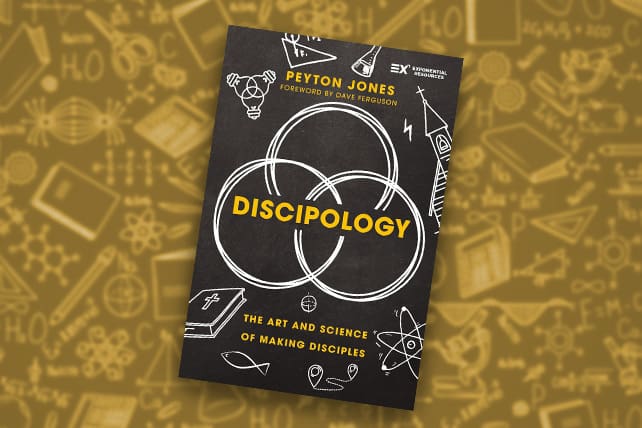
My friend Peyton Jones has a new book. This one is called “Disciplology,” which is not really a word. But he has a habit if making up words. (See his “Church Plantology” book.)
I enjoyed the book and endorsed it as follows:
Some books help us because they teach us truth we need to help us understand what things are true and what things matter. Some books we find to be useful to motivate, because they show us why things matter. Others are helpful because they explain how to put into practice what we know. Rarely do you find a book that does all three on an important idea, but that’s just what we have in “Discipology.” You will understand disciple-making at a new level by reading this important book.
With his permission, I’m sharing 20 truths from the book that you might find helpful.
And, be sure to order the book.
20 Truths From ‘Discipology: The Art and Science of Making Disciples’
“[W]hen we lift the hood on multiplication movements, both throughout church history and across the globe, at the core of all of them is an engine of mobilized people.” (10)
“Mobilization is defined as the Spirit-empowered process of activating ordinary believers into their God-given mission. Whenever mobilization happens, multiplication is the effect.” (14)
“Jesus’s mission strategy prioritized mobilization over multiplication. He knew that mobilization must precede multiplication—just as the Gospels come before the book of Acts.” (19)
“Discipology is built on the overlap of three key rhythms in Jesus’s disciple-making strategy: time, teaching, and tactics. When these three are practiced together, they produce mobilization…” (19)
“The first bottleneck to disciple-making is simple: Most of us don’t know how because it was never done to us. The truth is most Christians have never been personally discipled. According to a 2015 Barna study, only 23 percent of Christians are discipled one-on-one.” (30)
“Somewhere along the way, we confused the terms disciple-making and discipleship as if they are interchangeable. But they’re two different things. We swapped Jesus’s command to make disciples with the safer, more familiar substitute of discipleship, and that has confused everything since…We thought discipleship was what Jesus commanded in the Great Commission, but what he actually said was ‘Go. Make disciples.‘” (36)
“Discipology, then, is the art and science of making disciples. The science of disciple-making is drawn from the specific principles Jesus consistently followed as he made disciples.” (53)
“Each year of Jesus’s ministry emphasized one of the core rhythms—time, teaching, and tactics—forming a deliberate progression in how he made disciples.
- Year 1: He spent time with a small group of disciples, getting to know them, helping them to become disciples.
- Year 2: He taught them on mission, modeling how to reach others and training them for their ministry to be ‘fishers of people.’
- Year 3: He used tactics to send them on mission, going out ahead of him.” (58)
“Entering a disciple-making relationship presumptuously will lead to resentment. The lack of a mental contract or mutual understanding causes what Patrick Lencioni warns about—unshared expectations that lead to shared frustrations. The disciple-making relationship needs to be defined.” (62)