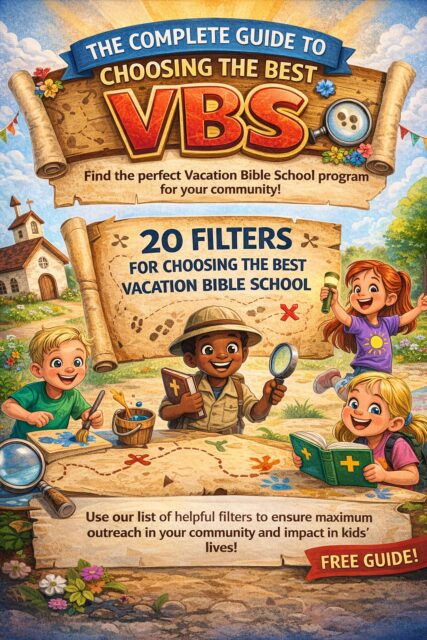
Use our complete guide to choosing the best VBS to ensure maximum outreach in your community and impact in kids’ lives. Choose the best VBS by using the following 20 filters we have used for years in VBS reviews.
The Complete Guide to Choosing the Best VBS
Educational Philosophy
1. Are the objectives clear?
Are there clear, concrete, measurable objectives? If your curriculum states as an objective for preschoolers that they would know the full joy of believing in God, how does a teacher measure that? Or if one states that young elementary children would share deeply about their faith, is that realistic?
2. Is it teacher- or student-focused?
What percentage of control does the teacher have? What are teachers doing? Are they telling, explaining, and saying for the most part? Or are they asking, directing, and observing? The teacher needs to function as one who is involved in the discovery process of learning, rather than the sole dispenser of knowledge.
3. Does it incorporate R.E.A.L. Learning?
This does not mean that children are simply busy. Instead, it means children are integrally involved in the discovery and learning process. So at its best, active learning evokes emotion in the children and helps them connect the learning experience to a real-life situation. Thus active learning involves open-ended debriefing questions that help kids “get the point.”
RELATED: 3 Easy-To-Understand Holy Week Activities for Preschool Kids
4. Does it incorporate the principles of interactive learning?
What a misused educational term this has been over the years. We’ve seen curriculums that claim to be interactive but are nothing more than children’s pencils interacting with fill-in-the-blank handouts. Interactive learning means that children do not learn in isolation. Rather, they learn best as they interact with others. So each group member contributes to the learning process.
5. Does it foster intrinsic or extrinsic motivation?
Reward programs are out; the joy of learning is in. If a curriculum relies on external reward programs to motivate children to be involved in learning, then there’s something wrong. The activities should be so compelling and exciting in and of themselves that children passionately engage in the learning process.
6. Do Bible memory activities focus on understanding and relevance?
Or is the goal of the program to simply have children parroting Bible verses at the end of the program—without really understanding the meaning or context?
7. Is it flexible enough to encompass all kids?
We look for suggested adaptations for kids with diverse learning needs and physical disabilities. We also consider if the content is appealing and meaningful for kids from a variety of backgrounds.
Content
8. Is it Bible-based?
Does the program use the Bible correctly and in context? Are the language and stories of the Bible age-appropriate?
9. Is it relevant to children?
Does it meet the “so-what” factor that would give kids a desire to learn about God’s Word? The content needs to delve into the heart issues that are important to children.
10. Does it focus on life application?
A VBS curriculum should not assume that kids will apply biblical principles. Instead, there must be open-ended questions that lead children to put their faith into action.