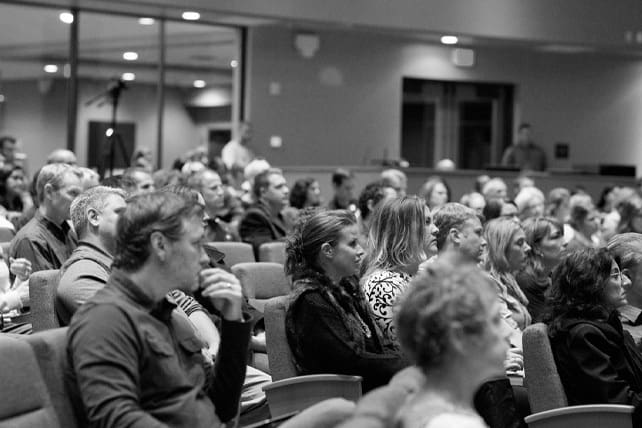
Why the Church Must Become the Center of Purpose Discovery
It was 1945. An Austrian psychiatrist sat in the ruins of a Nazi concentration camp, watching men die, not always from disease or violence, but from the quiet collapse of meaning. Viktor Frankl, who survived Auschwitz and Dachau, came to one of the most consequential conclusions in modern psychology: The deepest human drive is not the pursuit of pleasure or the avoidance of pain. It is the search for meaning.
He wrote it plainly in what became one of the most widely read books of the twentieth century: “Those who have a ‘why’ to live can bear almost any ‘how.'”1
Frankl never intended to write a theology. But he gave the church a mirror.
The Data Has Spoken. The Church Should Listen.
Ryan P. Burge, professor of practice at the Danforth Center on Religion and Politics at Washington University, released findings from Pew Research’s Religious Landscape Survey that deserve a seat at every church leadership table. Nearly half of all American adults, 47%, think about the meaning and purpose of life at least once a week. Two-thirds do so at least monthly. A staggering 97% engage these questions at some point.¹
Purpose-seeking is not a phase. It is a permanent human condition.
What makes Burge’s findings striking is the religion variable. The more religiously engaged a person is, the more they wrestle with meaning. Across all religious groups, frequent church attendance was the most predictive of weekly purpose engagement. Burge’s conclusion is direct: Attending church opens people to thinking about the higher things in life.2
The church isn’t just about helping those who are seeking, but also about inspiring everyone to ask deeper questions. It’s a place that nurtures curiosity and encourages personal growth.
A Moment the Church Cannot Afford To Miss
After decades of institutional decline, the data is shifting in ways that should electrify every pastor in North America.
Barna Group’s 2025 tracking data—compiled from more than 132,000 interviews—reveals a historic reversal: For the first time in decades, Gen Z and Millennials are now among the most consistent churchgoers, outpacing older generations. Among Millennials, 39% now report attending church weekly, up from just 21% in 2019. Among men, 43% attend weekly; the largest gender engagement gap Barna has recorded in twenty-five years of tracking.3
Barna CEO David Kinnaman frames the opportunity with precision: this renewed interest must be stewarded well.
Younger generations aren’t just returning to their grandparents’ church; they’re seeking purpose, clarity, and answers to life’s questions. When the church intentionally addresses this hunger, it will grow and flourish through them.
You Cannot Give What You Have Not Found
John Maxwell, in “The 15 Invaluable Laws of Growth,” identifies the Law of the Mirror as foundational to everything else: “You must see value in yourself to add value to yourself.”4 Remember, growing into who you are starts with believing in your potential. When we clearly understand our identity, we open the door to greater capacity. This truth applies just as much to a congregation.
1 Viktor E. Frankl, “Man’s Search for Meaning” (Boston: Beacon Press, 1959; reprint 2006), 76.
2 Ryan P. Burge, “Do People Think About Meaning and Purpose All the Time?” Graphs About Religion (Substack), March 2, 2026. Data sourced from the Pew Research Center Religious Landscape Survey. Burge is professor of practice at the Danforth Center on Religion and Politics at Washington University in St. Louis.
3 Barna Group, “Young Adults Lead a Resurgence in Church Attendance,” October 2025. Based on tracking data from 132,030 interviews over twenty-five years, including 5,580 interviews from January–July 2025. See also Barna Group and Gloo, State of the Church 2025. barna.com.
4 John C. Maxwell, “The 15 Invaluable Laws of Growth” (New York: Center Street, 2012), 43. Law 3: The Law of the Mirror.