
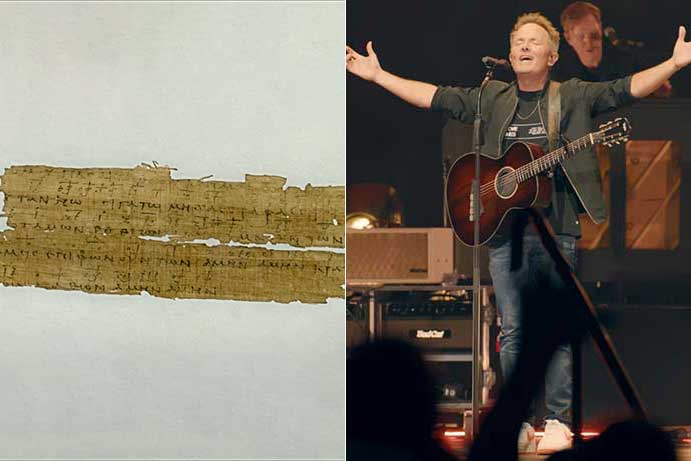
Grammy Award-winning Christian worship leader Chris Tomlin is helping bring back to life what is believed to be the earliest known Christian hymn in a new film, “The First Hymn,” coming to theaters March 24 and 26.
Tomlin told ChurchLeaders the project began when songwriter Ben Fielding invited him to collaborate on reviving an ancient piece of worship discovered on a fragment of papyrus dating back to the third century.
“First hymn is pretty amazing,” Tomlin said. “I mean, where do I even start?”
The ancient hymn, discovered in Egypt and later housed in Oxford, is believed to be approximately 1,800 years old and includes early musical notation.
RELATED: Chris Tomlin Hopes New Album Continues the Faith Awakening He Saw at Charlie Kirk’s Memorial
“It’s this earliest known hymn of the church,” Tomlin said. “It dates to the 200s—1,800 years ago—that we know what the early church around this early underground church was singing.”
Tomlin admitted he initially felt overwhelmed by the responsibility of adapting such a historic piece.
“I was a bit like, I don’t know if I’m up for this. That’s a big responsibility,” he said. “But man, I’ve learned so much. I’m so grateful as someone who’s given their life to this kind of work of writing songs for the church to be a part of something that’s the earliest known song that we have. [It] is so special to me.”
What stood out most to Tomlin was the song’s singular focus on God.
“The first song that’s ever been discovered is a song that is just pure. It’s not anything about us,” he said. “It is just worship.”
RELATED: Chris Tomlin’s New Song Resurrects the World’s Oldest Known Hymn
The “How Great Is Our God” singer continued, “I found that those songs are the ones that change the room. That’s what changes people’s lives: when it lifts our eyes to the greater story of the kingdom of God.” He said, “And even then, the very first song is just about the praise of God. That’s so beautiful to me.”
The lyrics, which call all of creation to reverence and praise, conclude with a bold declaration: “To the only giver of all good gifts.”
Tomlin noted that phrase carried significant cultural weight in the Roman world, where such language was commonly directed toward Caesar or pagan gods.
“For them to say in a Roman persecuted world, ‘to the only giver of all good gifts,’ was quite a statement to culture at the time and was quite a powerful statement,” he said.
During the interview, Tomlin reflected on the ongoing conversation surrounding hymns versus modern worship songs, pushing back on the idea that one era’s music is inherently superior.


