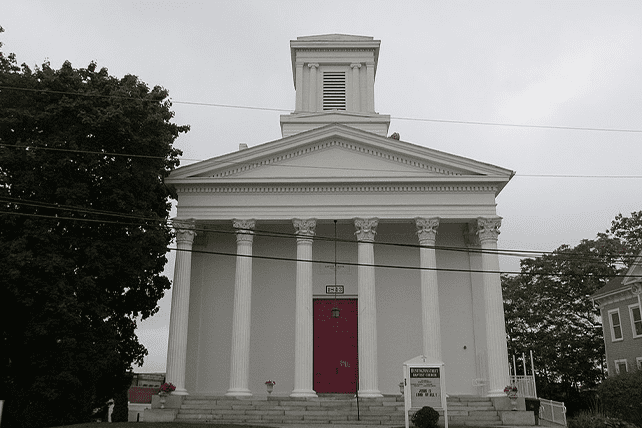
The Church at 29 Huntington Street: Where American History Meets New Beginnings
How One Man’s Letter to Thomas Jefferson Led to 175 Years of Ministry in New London, Connecticut
On December 30, 1801, President Thomas Jefferson received two unusual deliveries at the newly established capital in Washington, D.C.
The first was a massive wheel of cheese—1,235 pounds of it—sent from Massachusetts Baptists with a card declaring it “The greatest cheese in America for the greatest man in America.”
The second was a letter. A carefully worded appeal from religious leaders in Connecticut who were fighting for something we now take for granted: the freedom to worship without government interference.
Jefferson read their letter. On New Year’s Day 1802, he sat down to write his response. In that reply, he penned sixteen words that would echo through American history: “Thus building a wall of separation between Church and State.”1
You’ve heard that phrase. Everyone has. It’s been quoted in Supreme Court cases, debated in political campaigns, and argued over in countless discussions about the role of religion in American life.
But here’s what you probably don’t know: One of the six men who received Jefferson’s letter ended up in New London, Connecticut. His ministry set in motion a chain of events that led to the construction of a magnificent Greek Revival church building in 1843—a building that still stands today at 29 Huntington Street.
And on Easter Sunday 2025, that same historic building launched a new chapter: On The Rock Community Church.
This is the story of how a fight for religious freedom in 1801 connects to a church replant in 2025. It’s a story of triumph and failure, of theology and providence, of buildings that change hands and a gospel message that never changes.
It’s a story worth telling. And if you live anywhere near New London, it’s a story that might just lead you to visit a church with deeper roots than you ever imagined.
The Men Who Wrote to Jefferson
Let’s go back to 1801.
Connecticut wasn’t like most other states. It had an official state church—the Congregationalist Church—supported by taxpayer money. If you were Baptist, Presbyterian, Methodist, or anything else, you still paid taxes to support the Congregationalists. Your religious liberty existed as a favor from the government, not as a right.
The Danbury Baptist Association had enough. Twenty-six churches covering western Connecticut banded together and chose six leaders to write to the new president. They needed assurance that their rights would be protected.2
Among those six men was Nehemiah Dodge, a Baptist elder who had begun ministry in Hampton, Connecticut, in 1788 before moving to Southington and Farmington.3 Dodge was a fighter—he published tracts, argued for disestablishment, and refused to accept second-class status for his faith.
The letter they sent Jefferson was direct: “Our Sentiments are uniformly on the side of Religious Liberty—That Religion is at all times and places a Matter between God and Individuals—That no man ought to suffer in Name, person or effects on account of his religious Opinions.”4
Jefferson got it. He understood what was at stake. His response became one of the most influential documents in American constitutional interpretation.
But that’s the famous part of the story. The part most people don’t know comes next.
From Baptist Champion to New London
About twenty years after writing to Jefferson, something happened to Nehemiah Dodge. He left the Baptist ministry and became pastor of the Universalist Church in New London, Connecticut.5
1 “Danbury Baptist Association to Thomas Jefferson, [after 7 October 1801],” Founders Online, National Archives, https://founders.archives.gov/documents/Jefferson/01-35-02-0331 (Original source: The Papers of Thomas Jefferson, vol. 35, 1 August–30 November 1801, ed. Barbara B. Oberg. Princeton: Princeton University Press, 2008).
2 “Minutes of the Danbury Baptist Association, Holden at Colebrook, October 7 and 8, 1801,” Hartford, 1801.
3 “Reply to the Danbury Baptist Association [Editorial Note],” Founders Online, National Archives, https://founders.archives.gov/documents/Jefferson/01-36-02-0152-0001.
4 Thomas Jefferson to Danbury Baptist Association, January 1, 1802, Writings 16:281.
5 “Danbury Baptist Association to Thomas Jefferson.”