
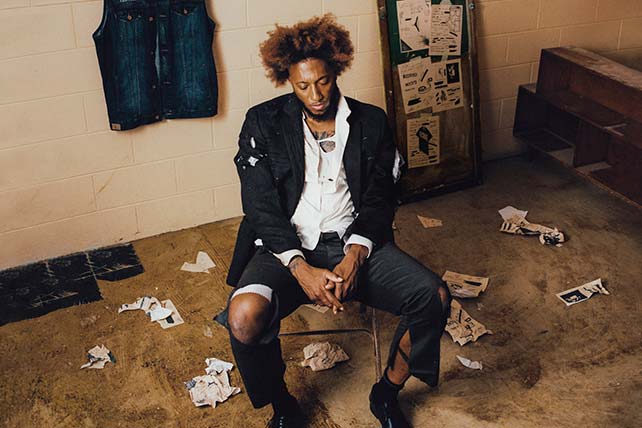
Most Christian artists talk about faith in safe, polished terms. Lecrae went the other direction.
Over the past several years, the Grammy-winning rapper has spoken openly about losing his grip on church, on theology, and at certain points, on God himself. The conversations showed up in interviews. They showed up on social media. And they showed up most rawly in his music, specifically in the Church Clothes series, where Lecrae documented the unraveling and the rebuilding of his faith in real time.
If you’ve heard bits and pieces of his story and want to understand the full arc, this is it.
What Triggered Lecrae’s Deconstruction
Lecrae didn’t drift from faith because of doubt in the abstract. His deconstruction had a specific starting point: the murder of Michael Brown in Ferguson, Missouri in 2014 and the firestorm that followed.
When Lecrae tweeted about the pain he felt as a Black man watching the story unfold, a significant portion of his Christian fanbase responded with hostility. He was accused of being political. Of abandoning the gospel. Of not staying in his lane. The rejection didn’t come from the culture. It came from the church.
“I would speak at churches, hang with leaders and such. You know, Judah, Piper, and Keller, Tony Evans was clutch. I was so involved, never thought that I could fall. Right before the fall of 2015, I was all off.”
He had spent years embedded in the Reformed evangelical world, speaking at churches, building relationships with prominent pastors, and operating as a kind of cultural bridge between hip-hop and conservative Christianity. When he raised his voice on race, many of those bridges broke.
The Moment With Voddie Baucham
Among the hardest parts of Lecrae’s story is what happened with Voddie Baucham, a theologian he had deeply respected and met with multiple times.
“Voddie was a hero of mine, met with him plenty of times. This time, when he spoke, it cut me deeper than I realized. Doubled-down, spoke about my pain, I was met with blame. Shame on you, Crae, stop crying, get back to Jesus’ name.”
That moment, being told by a pastor he admired to stop expressing pain and get back to preaching, sent Lecrae into a spiritual freefall. His lyrics describe the months that followed in stark terms: alcohol as self-medication, questions about whether God existed at all, thoughts about divorce, and a slide into clinical depression.
He wasn’t performing crisis. He was living it.
What Lecrae Actually Means by Deconstruction
The word deconstruction gets used loosely in Christian circles, often as shorthand for “leaving the faith.” Lecrae is careful to push back on that framing.
In his own words: “The goal of a healthy deconstruction is reconstruction. When you find out you have mold in your house, you’ve got to tear it out. We’re not saying you break up the foundation. We’re not saying you take away the foundation, which for us, as followers of Christ, is Jesus himself.”
The distinction he draws is between Christianity as a set of cultural and political assumptions versus Christianity as genuine faith in Christ. He argues that a lot of what gets called “Christian” in American evangelicalism is more cultural than biblical, and that pulling those things apart is not the same as walking away from God.
Deconstruction, in Lecrae’s framing, is diagnostic. You tear things down to find the damage, not to abandon the structure entirely.


