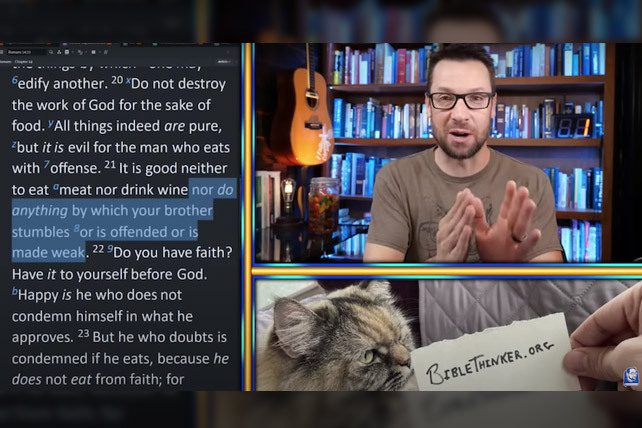
Lust does not work that way. When a man struggles with lust, no one is encouraging him to lust alongside them. The struggle is internal. That is categorically different from what Paul is addressing.
“Nothing in Romans 14 mentions clothing, modesty, or lust,” Winger said. “The examples are of people participating in certain behaviors and encouraging others to participate in those same behaviors. Paul’s instructions do not apply to lust.”
The Burden We Put on Women
This is where the conversation gets uncomfortable, and it is also where Winger is most direct.
If the standard for what a woman can wear on stage is determined by whether any man in the building might experience lust, the standard becomes impossible to meet.
“Limiting women from wearing clothes that cause any man in the house to feel lust is so broad that women would be limited to wearing, like, burlap sacks,” Winger said. “And even then, someone would still find a way to lust. It is too heavy of a burden to place the lust of man on the shoulders of women.”
This has real implications for how churches build their modesty culture. A dress code rooted in managing male lust places moral responsibility for someone else’s internal experience onto a person who had nothing to do with it. That is not what Romans 14 teaches. It is not what the broader biblical witness supports either.
Jesus is direct in Matthew 5:28: the person who looks at another with lust has already sinned in their own heart. The sin belongs to the one who lusts, not the person being looked at.
That does not mean clothing choices carry no moral weight, or that there is no place for discretion on stage. But the framework matters enormously, and many churches have built their modesty culture on one the Bible does not actually endorse.
Should Your Church Have a Dress Code for Worship Leaders?
This is where practical wisdom comes in, because Scripture does not hand you a policy.
Churches are communities, and every community makes decisions, implicitly or explicitly, about how people present themselves in public ministry roles. That is not inherently wrong. A pastor wearing a tuxedo to every service is making a statement. So is one who shows up in board shorts. Context shapes what is appropriate.
The problem comes when dress codes are grounded in protecting men from their own internal struggles rather than any positive theology of worship. It compounds when those codes target women while ignoring male leaders, when they function as control rather than genuine pastoral care, and when they are enforced without clear reasoning or biblical grounding.
Winger is careful here. He thinks the yoga pants question is real and worth thinking through. But he warns that when people push to restrict what worship team members wear simply because they personally dislike it, rather than for any grounded biblical reason, ‘you start to turn into oppressors of the people that are in ministry.’
A healthy dress code conversation starts with a positive vision, not fear. What does it look like to lead worship in a way that draws attention toward God rather than toward oneself? That question can get somewhere. The “someone might lust” starting point rarely does.
What Thoughtful Church Leaders Are Doing
Many churches have moved toward general guidelines rather than specific prohibitions. The most common approach focuses on distraction rather than lust, asking whether clothing pulls attention away from worship rather than whether it could theoretically tempt someone.
Others frame it around role. Worship team members hold visible leadership positions, and visibility comes with a degree of self-awareness about presentation. The same expectation applies to preachers, greeters, and anyone else who regularly stands in front of a congregation.
What tends to fail: policies built from reactive incidents, applied only to women, and communicated without pastoral sensitivity. What tends to work: ongoing conversations about the theology of worship and what it means to present oneself as a servant rather than a performer.
The goal is not compliance. It is formation.