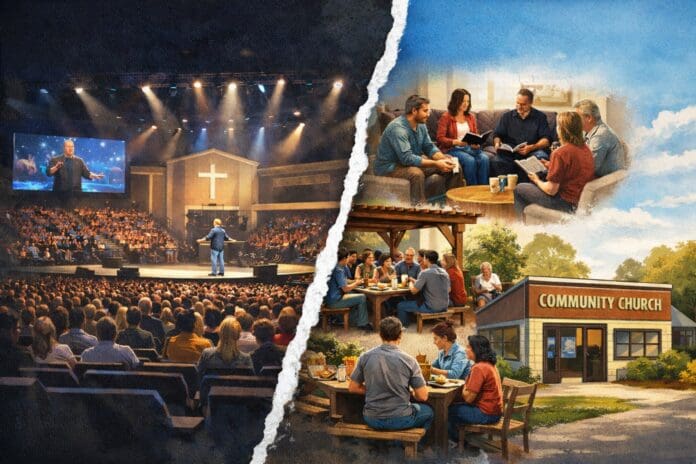
Church leaders hoping for growth today stand at a crossroads. For decades, the archetype of church growth in many Protestant circles was a large, purpose-built campus with thousands gathered under one roof, a dramatic stage for worship, and a comprehensive suite of ministries. But ministry patterns are shifting. Amid broader institutional skepticism, financial pressures, and renewed interest in relational discipleship, a compelling case has emerged for micro-church institutions, smaller, decentralized expressions of church life, as a wiser investment than costly mega builds.
This shift is not simply architectural; it reflects deeper theological, cultural, and missional realities that leaders cannot afford to ignore.
From Mega Builds to Strategic Micro-Church Strategies
The megachurch phenomenon has undeniably shaped modern evangelicalism. Drawn by dynamic preaching, polished worship, and expansive programming, millions attend churches with congregations in the thousands. Mega campuses often offer multiple services, vibrant community outreach, and a wide array of ministries designed to meet diverse needs. Proponents point to compelling sociocultural impact, broad networks of service, and the capacity to mobilize resources at scale.
Yet this model has limitations. Large buildings require vast capital, complex operational systems, and ongoing maintenance costs that can strain a congregation’s finances and distract from core discipleship work. Beyond expense, mega builds often struggle to cultivate deep relational bonds, a key ingredient in spiritual formation and communal vitality. Many members describe large congregations as places where one can attend weekly yet remain socially unknown or emotionally distant from others.
As a result, church growth experts have documented an important trend: many megachurches are redefining their expansion strategies, emphasizing multisite campuses, microsites, and smaller community hubs rather than ever-larger sanctuaries.
RELATED: The Pandemic Has Led Us to Decentralized Worship
Relational Depth Over Physical Scale
One of the most persuasive arguments for micro-church institutions is rooted in human relational capacity. Anthropologist Robin Dunbar found that humans can sustain stable relationships only up to a certain number—approximately 150 individuals—before relational depth diminishes. Church leaders and researchers point to this insight to explain why many congregations stall or lose vital connection as they grow beyond a few hundred people.
In micro-institutions, be that house churches, neighborhood faith communities, or small campuses, leaders and members are more likely to know one another, pray for one another, and engage in everyday life together. This relational intimacy fosters authentic discipleship in ways that large auditoriums cannot replicate. The church is not its building; it is the community of believers. Personal relationships carry incarnational ministry into the week, not just into Sunday services.
The church is not its building; it is the community of believers.
Deep relational bonds also correlate with increased volunteer engagement, better pastoral care, and greater lay participation. In smaller settings, more people are needed in visible roles, and more are empowered to lead. Leadership becomes participatory, not a rarefied function of a small professional staff. This means disciples multiply not just in numbers but in spiritual maturity.