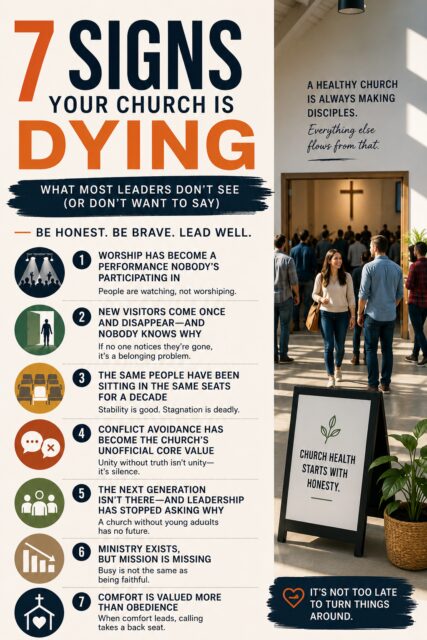
5. The Next Generation Isn’t There — and Leadership Has Stopped Asking Why
The most revealing moment in any church is not the Sunday service. It’s the Wednesday night gathering, the small group, the volunteer team. Look around the room. What’s the average age?
A church without young adults in their twenties and thirties is not a church with a youth problem. It is a church with a fifteen-year countdown clock. And the churches that are furthest into that countdown are almost always the ones that stopped asking the hard question years ago: why are they leaving, and why aren’t they coming back?
RELATED: 10 Reasons Youth Leave the Church
The answers are uncomfortable. Young adults are not leaving because of worship style, parking, or coffee quality. They are leaving because they encountered churches that were more interested in their attendance than their discipleship, that offered answers to questions they weren’t asking, and that had no visible place for them to belong, contribute, or lead.
When a church stops genuinely wrestling with why the next generation isn’t present — and settles instead for blaming the culture, the phones, or “kids these days” — that church has chosen its own comfort over its mission. And the mission will not wait.
6. Giving Is Quietly Declining and Nobody’s Allowed to Say So
Finances are one of the clearest diagnostic tools available to church leadership, and they are almost universally ignored until they become a crisis.
Gradual giving decline rarely announces itself. It shows up in budget conversations that get tighter each year. In the capital campaign that gets quietly shelved. In the staff position that goes unfilled. In the pastor who stopped giving the stewardship sermon because it felt awkward the last two times.
Giving patterns in a church track directly with engagement, trust, and mission clarity. When people are deeply connected to a church and believe in what it’s doing, they give. When connection fades, when trust erodes, when mission becomes fuzzy — giving reflects it first, often years before the attendance numbers follow.
RELATED: Church Finances: Why Giving Stays Strong While Attendance Drops in Churches
This is worth saying plainly: If your church’s giving has been flat or declining for more than two consecutive years, you do not have a generosity problem in your congregation. You have an engagement and vision problem in your leadership. Treating the symptom without naming the cause is how churches drift toward insolvency without anyone ever having an honest conversation about it.
7. The Pastor Is Exhausted and Isolated — and the Elders Haven’t Noticed
This is the sign that precedes all the others, and it is the one least likely to be identified until it’s too late.
Pastoral burnout is not a personal failing. It is a structural failure — of boards that measure pastors by Sunday attendance instead of spiritual health, of congregations that treat their pastor as a professional service provider rather than a shepherd who also needs shepherding, of church cultures that have confused busyness with faithfulness and output with calling.
The exhausted, isolated pastor does not always look exhausted. They preach well. They return calls. They show up. But the well is dry, and has been dry for longer than anyone knows, because pastors learn early that the cost of honesty about their own depletion is higher than the cost of pretending to be fine.
RELATED: Loneliness in Ministry: What Barna and Gloo’s State of the Church Data Reveals
When a pastor is leading from an empty place, everything downstream is affected. The preaching loses its edge. Decisions get made out of self-preservation rather than vision. Difficult conversations get avoided. The team senses something is wrong but can’t name it. And the slow, quiet decline that started in the pastor’s soul begins to spread through the entire body.
Elders: when did you last ask your pastor — genuinely, with no agenda and no time limit — how they are actually doing? Not the ministry. Them.
If you can’t remember, that is your answer.
RELATED: 7 Powerful Ways Pastors Can Prevent Burnout and Stay Spiritually Strong
What You Do With This Matters More Than What You Read
None of these signs are death sentences. Every one of them is reversible — but only if they are named honestly, owned without defensiveness, and addressed at the root rather than the symptom.
The churches that recover from slow decline are not the ones with the best programs or the biggest budgets. They are the ones with the courage to sit in an uncomfortable room, look at what’s actually happening, and say out loud: this is not where we want to be, and we are willing to do whatever it takes to find our way back.
The churches that don’t recover are the ones that read something like this, nod quietly, and change the subject before Sunday.
Which kind of church are you?