
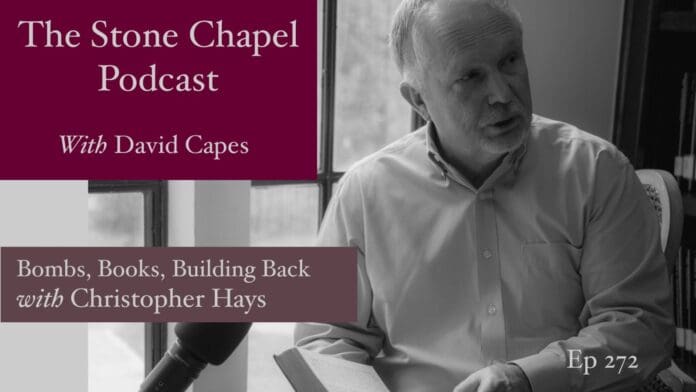
David Capes
But now it sounds like they’re viewed as real partners because of their work in preserving Ukraine.
Christoper Hays
I think that’s right.
David Capes
There’s a story that you began telling me over lunch about this library that was destroyed. In what city is this located?
Christoper Hays
Yew. This is the story of Tavriski Christian Institute in the city of Kherson. And for those who have followed the maps of Ukraine, Kherson is on the southern tip of the country. It was right across that river that the Russians came on the first day of the war for the invasion. So Tavriski Christian Institute had a beautiful campus on that river, which today is the front lines between the Russian trenches and the Ukrainian forces.
The second day of the war, their campus was overrun by the Russians, and my friend, Valentyn Sini, who is a scholar leader, one of the people that we supported for his doctorate, with whom we had worked on his executive strategy and financial sustainability. Valentyn led his campus community across the country to the west, to a place called Ivano-Frankivsk. While he was on the road, he was already working with Taras Dyatlik and a number of our other seminary president friends in Ukraine to begin to put into place this refugee work that I’ve just referred to beforehand.
When he got to Ivano-Frankivsk with his busted-up seminary vans, the first thing that he did was to buy another van and to start running humanitarian aid back and forth between Kherson and the West. Over the course of the ensuing months, a couple things happened. The Russians occupied his campus. They turned his dormitories into barracks. They defiled his office. They ended up using his campus as a crematorium. Then when the Ukrainians came and retook control of the campus, they destroyed the library. They burned all the books, because those are Western propaganda. It was one of the best theological evangelical libraries in Ukraine. And they planted land mines in the campus before retreating.
David Capes
Land mines. Lovely.
Christoper Hays
So they cannot go back, even today. It’s on the river. It’s in the line of sight for Russian snipers and artillery.
David Capes
Would they shoot a seminary student?
Christoper Hays
Absolutely! Thereafter, when it became clear that they could not go back to Kherson, they moved their seminary community to Kiev. They found a building that was rented to them that they are now in the process of purchasing. And they began to ask, “What does it look like to restart residential theological education?” Because if you’re going to do training for pastors in a country where, literally, the majority of the population is traumatized, you need to be a healing community. And that’s just going to be much better if you do it in person than online.
So what’s the first thing you have to have if you’re going to resume residential education? What’s the thing you’ve got to have before anything else? I mean, you can use anything as a desk. You can sit anywhere. You can do courses. You can do classes on the floor or under a tree or whatever. But you’ve got to have books. We jump forward to February of 2024, I’m sitting with Evan Hunter in Valentyn’s new office in Kiev, and we have, just a week beforehand, inked the deal for us to acquire a theological book network. And Valentyn shares with us that they have this need for this library. In fact, if they don’t have books, they are going to lose their accreditation with the government. And there is a library available at Lincoln Christian University in Illinois.
David Capes
That’s right. I remember reading about that.
Christoper Hays
It is an amazing opportunity. They were willing to give their books away. But how do you get books from Springfield, Illinois, to a war zone? And we said, well, we’ve got a guy!
David Capes
I know a guy!
Christoper Hays
We do! We got the team of theological book network up and running. Scott Watson heads down to Springfield, Illinois. He leads a team there to pack up all the books to ship, to get them up to Grand Rapids so that we can package everything for shipping. We put some of our best postgraduate collections from our own warehouse into it, and our guy, Rollin Timmerman, who has been running logistics for TBN for 19 years all over the world. He is able to buy hook and crook and all sorts of extraordinary imaginations involving trucks and ships and cranes. He is ultimately able to get this amazing collection, over 20,000 books into Kiev. I was there in August for the ribbon-cutting ceremony, and they have a library again.
David Capes
They have a library. How beautiful. It’s a pretty cool thing. So what are they doing for residences at this point? Do they have that sorted out?
Christoper Hays
They have a building for lodging there, so students are living on the campus together, where they’re having courses. They’ve got to cook on campus, and they’re rebuilding lives and retraining people for ministry.
David Capes
Doing theology in wartime. That’s something that’s near and dear to your heart.
Christoper Hays
Well, yes, it is. You were kind enough to have me on this podcast before, as we talked about the book that I did, “Eight Million Exiles,” responding to the crisis of forced displacement and civil war in Colombia. That meant that when Valentyn was sharing with me about his desire to do a theology around wartime issues in Ukraine, and he asked me to join him, I was delighted to do so. So Valentyn and I, along with Evelyn Reynolds, who’s one of SL vice presidents, have just finished drafting a book called Theology in Wartime: Ukrainian Dilemmas, all about the sorts of issues that are forced upon Christian leaders by the experience of war.
And Valentyn has also published a wonderful memoir his first year in the war. The book is called, “Serving God Under Siege.” It’s just come out, published by Eerdmans, and if you want to hear about it, we have an episode on our podcast. Our podcast is called Faith on the Road. It’s a Scholar Leaders podcast with majority world theological leaders so you can hear Valentyn and I chat about serving God under siege and the faith on the road podcast.
David Capes
I can’t wait to hear it. That’s super. We have an essay at the Lanier Theological Library, the handwritten essay by C.S. Lewis entitled, “Learning in Wartime.” He gave this address at the college where he was teaching to a bunch of young men, mainly who were there when the Second World War broke out. It’s an amazing address. We have the original, which is fantastic. It’s now on loan to the Museum of the Bible because they’re doing a big C.S. Lewis exhibit. The essay is in the book called, “The Weight of Glory.” And people wonder, why are we doing this in wartime? Why don’t we just take up arms and fight the Russians? And why is it important to do theological education in the middle of a war? How did you
answer that?
Christoper Hays
Well, the way that Lewis answers it, if I remember correctly, in that essay, is he says, because someday the war will be over. And that is certainly a true thing to say and a good reason to do theology in wartime. But it’s only part of the answer. You do theology in wartime because the Church needs to be the church during wartime. The church needs to answer questions now about whether or not you flee or you remain. They need to answer questions now about how to build a home in a new place. They need to ask their questions now about whether or not you fight back. Can a Christian kill? They need to answer questions now about faith and doubt and death and resurrection.
The Church has to be the church during wartime. Tertullian famously said the blood of the martyrs is seed. It’s the seed of the church. The idea is that the suffering faithfully of Christians is what ultimately helps the church to grow, and that has often proven itself to be true, but you have to suffer faithfully, and so theology in wartime has to be done to help the church to be the church in the midst of its greatest darkness.
David Capes
When will that book be published?
Christoper Hays
Well, I’m hoping to have a conversation with the publisher about it at SBL in a couple of weeks.
David Capes
Hopefully, it will be published next year sometime. I am hopeful for that.
Transcribed by https://otter.ai
