
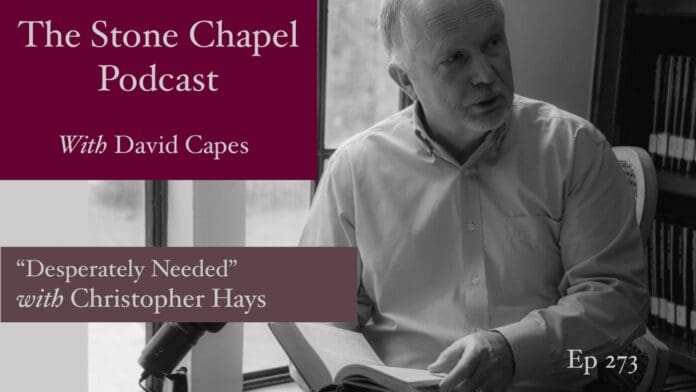
Christoper Hays
Man, this is a cool thing. So a little bit of backstory on the logic of this. The pandemic hits us in 2020, and all of us go on lockdown. All of us who are professors, go online, even if we had been residential professors beforehand. I was in Medellin, Colombia at that point. We had a very severe lockdown that lasted a lot longer than in a lot of Western countries.
Of course, we don’t have formidable internet databases or anything like that, like a good Western university would have. Man, I just ran into this wall trying to find good resources for my students. I went and did the legwork to try to find what I could that was out there electronically with the limited subscriptions that we had. And I was just so crestfallen, and I watched the way that my students’ performance suffered rapidly.
This accelerated the global theological education community’s awareness of the need to be able to resource online education much faster than we would have realized had the pandemic not pushed all of us online, and one of the groups that was recognizing the need for this was Theological Book Network. This is before we merged together. They had been all about the physical book world, and we still are about the physical book world, but they said we need to figure this out. So they began to build a digital library, which we have completed and launched in September of this year. It’s called Bibliotech, and it is exclusively for majority world seminaries.
David Capes
Being here in the United States, I couldn’t log into it. I couldn’t be a part of that.
Christoper Hays
You could not I’m afraid. We’re trying to create an instance in which as majority world students actually have an advantage over a Western student. And one of the reasons that we do that is because we’re focusing exclusively on the majority world, Western publishers have decided to be extraordinarily generous with the licenses they’ve given us.
So we have nine Western publishers that have given us their books for Bibliotech, for the majority world at next to nothing. Eerdmans, IVP, Baker. We’ve got Fortress, Westminster, John Knox. We’ve got Society of Biblical Literature, Lanier Regnum. These are the right publishers with the right books, and they are allowing us to create this carefully curated collection, not a bunch of bloated books.
Our goal isn’t to have 20,000 books, of which only five of them are useful. We want everyone to be one of the right books. And then we’ve built them into what is effectively Netflix for seminary libraries. So it’s a subscription model. You can download your books, you can use them offline if you’re in a jungle village with very little internet access or no internet access. But we got a couple things that are super cool. We’ve got built-in AI translation technology.
David Capes
Now, you were telling me about this earlier, and we talked about a friend that we have who’s going to be here to lecture, Lyndon Drake (January 9-10, 2026).
Christoper Hays
Yes, that’s right. Lyndon Drake is working with us on a big, ambitious project that I would love to come back in a year and tell you all about. Man, AI, there’s all sorts of reasons to be worried about it. But one of the places that it’s been fantastic is with translation. We have built translation into this app, so students who are from Francophone Africa or from Latin America, for whom these English books would be out of reach, can utilize them. But not just that.
Our goal is not just to get good Western literature to the majority world, although that is certainly a big goal and a value. Our moves right now are about getting majority world literature from good majority world publishers into Bibliotech. I’m in conversation right now with a few of the right Latin American publishers. There’s a bunch of wonderful stuff that was done by the Latin American Theological Fraternity in the 70s, through the 90s. Most of it’s never been translated out of Spanish, and yet it would be so important to people in India or in the Philippines or in Central Africa.
David Capes
So the idea would be to get these Spanish books and make them available in Hindi or make them available in some other language.
Christoper Hays
You open Bibliotech, and the student who’s working in Hindi can just pop it open. And we’re not going to stop with Spanish. We want to get Arabic in there. We want to get Francophone African literature in there, because we think that the majority world students should be reading good stuff from Baker, IVP, Eerdmans, etc. There are helpful things that we theologians have been doing. But I want the guy who is in Pakistan to be reading what the guy from Ecuador wrote. I want Ukrainians in the context of war to be reading what was written in Arabic by Palestinians, because it’s the conversation between the majority world that is going to accelerate our advances in responding to the sorts of issues that beset the majority world far more than people trying to read and extrapolate from a Western theologian.
David Capes
This is in process?
Christoper Hays
Bibliotech has launched. It’s launched, and already taking subscriptions, right now.
David Capes
All right, all right. So I can pretend that I’m in Zimbabwe and get this!
Christoper Hays
Move to Zimbabwe and teach there David, and you, for the price of a single book, will get yourself a digital library.
David Capes
So if people wanted to invest in this and to invest in this theological library, would they do that through Scholar Leaders?
Christoper Hays
Absolutely! We would be grateful for continued development as we build this out.
David Capes
You all have just moved from a narrower focus to now, a very broad focus. You are trying to be such a great resource for theological education to the rest of the world where the gospel is moving forward. We may see our churches a bit dry and less than full here, but something else is happening in other places.
Christoper Hays
You know, there is still numerical growth happening in Western churches, percentage wise. In certain places, we’re losing ground, but there’s still numerical growth happening. In the majority world, on average, the numerical growth is 13 times faster than it is in the West. So that’s where we’re putting our energy.
David Capes
But we have all the resources in the West. But now we’re getting those resources available elsewhere. That’s exciting.
Christoper Hays
Yes! So, if you want to learn more, if you want to invest in this, go to scholarleaders.org.
David Capes
That sounds great. Dr. Christopher Hays, thanks for being with us today on “The Stone Chapel Podcast.”
Christopher Hays
I’m looking forward to the next time.
Transcribed by https://otter.ai
