
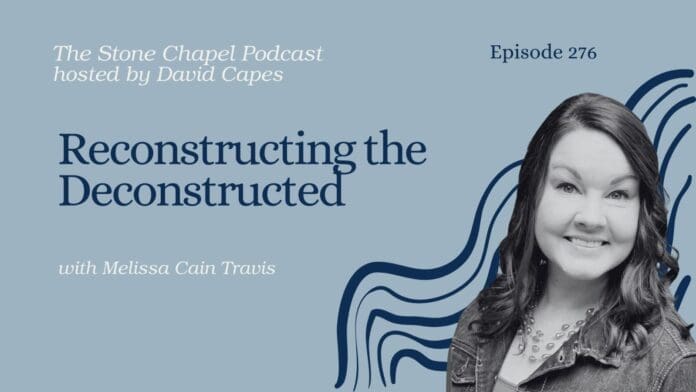
Melissa Cain Travis
Right. In this particular chapter, I do a little bit of a survey of the lay of the land and talk about why Christianity is the ultimate and the only grounding for a good and happy, flourishing life as a human being.
David Capes
I remember reading some about that in C.S. Lewis years ago, and there’s other writers too that have taken that up as well. But I think that’s a brilliant way to begin the book, because there’s the search for significance that everybody has, And we want to be significant. We don’t want our lives to be just a tragic accident, a cosmic accident. We’re not here but for any reason other than the fact that the cosmos just happened to throw these pieces together. The nod to fate, as it were. Fate is ruling everything.
You wrote some of the chapters, and your co-author wrote some of the chapters. But you wrote on top of each other, which I always find significant. You always comment on each other because you want it to be a joint book. Was there a particular chapter that you found the hardest to write or to write together?
Melissa Cain Travis
I would say there was. The chapter that was probably the biggest challenge for us was chapter seven, and that’s the one that addresses violent crusades and inquisitions. It wasn’t that we disagreed on the content of the chapter. It’s that Ike is so passionate as a pastor in helping people understand that, yes, Christians too are sinful, and Christians too fail. We’ve made massive mistakes in some parts of history. And let’s talk about what Scripture tells us and how things should have happened and so forth, which I think is tremendously valuable. I’m more inclined to say, let’s look at the historical record, and let’s ask questions like, what really precipitated these inquisitions and crusades, what really went on during these periods. Is it as bad as all of the pop culture talking points that you hear?
David Capes
I’m wondering, because in pop culture sometimes there’s the writing of history, and then there’s the rewriting of history. And then the rewriting of the rewriting of history. And a lot of times we don’t really know the whole story.
Melissa Cain Travis
There are little pieces that are plucked out and emphasized and the whole thing becomes distorted. That was our challenge to say within this many thousands of words for this one chapter, how can we get plenty of both and serve our readers really well. We both learned a lot from researching and writing that chapter, and things I’m very glad to know now about the messiness of human history. And the messiness of the church having to be in this world and interacting with different groups of people from different faiths and political dynamics. All the things that just make things difficult and messy to navigate.
David Capes
And human history is messy, when you look at it. I think it was Richard John Neuhaus that said something like, violence when justified is not an option, but a sad duty. There are times that violence might be the right response to something which seems to be against, at least on the surface, some things Jesus talks about. But when you look at the historical record and what happens in history, sometimes maybe violence is justified.
Melissa Cain Travis
Yes, right. The chapter goes on to talk about who was defending, who. Who was fighting, who. Who invaded first, Who was taking back for just causes. And there’s not a whole lot you can cover in one chapter of a book, but we feel that we’ve addressed the topic rigorously and pastorally, and we hope it really does serve the readers well.
David Capes
More recently, I think the charge of Christians or Christian leadership at least, is that we can be and have been abusive to people. Those are a little bit more current.
Melissa Cain Travis
Right. And as I said, he does such a tremendous job coming at it from a pastoral perspective and helping Christian readers see that some of this we need to simply, in all humility, acknowledge that some terrible things have happened and do happen within the context of the church. There is a lot that needs to be repented for in that regard, but we’ve got to always come back to what does Scripture teach about these things. And it gives us the grounding to condemn it at the end of the day. How should we be behaving in the church?
David Capes
I have a rabbi friend that says it this way, if people violate their faith, you can’t blame the faith itself. You can only blame the people who have violated the faith. It’s not the faith that is the problem. It is the people who are not living by the faith. I think that’s an important thing to keep in mind.
Now, a lot of your focus has been on science. The latter chapters of the book deal with issues of science, with evolution, that Christianity is anti-science. I’ve often thought of science as an abstraction. Because to some degree, science never seems to be settled very long on any one question. This might be current right now, and then fifty years later, they’re saying something else. It seems to be a moving target. Is that part of the problem? Is it Christianity against scientist, rather than Christianity against science?
Melissa Cain Travis
I delve into the philosophy, first and foremost, to talk about the different perspectives that were coming at the discipline. A Christian is coming at the discipline of science, broadly speaking, from a theistic world view, in which mind is fundamental to all existence. There is a mind behind all things, the mind of God. Whereas the non-theist is coming at the discipline of science, broadly speaking from a non-theist framework. Such that matter or matter and energy and the laws of nature are the fundamental thing.
David Capes
And the only thing.
Melissa Cain Travis
And the only thing, right. We’ll often hear the term materialism or naturalism associated with that view. I talk about the conflict really being at this fundamental level. The conflict is not that science and religion are at odds. They’re not. It’s these underlying philosophies that are at odds. But as you said, science is one of these fields that is constantly changing. Things that seem settled 10 years from now, will not be so settled, or will be completely different. This is one of the things that C.S. Lewis talked about in an essay entitled Christian Apologetics. He said, “Do not pin your apologetic on one scientific finding or
another, because tomorrow you might find the rug pulled out from under you because it’s replaced with a different scientific theory”.
My perspective on the science and faith conversation is that we really have to have the conversation at the philosophical level first and ask questions. How is the data pointing when we look at it holistically? Do things seem to be pointing more towards mind being fundamental to nature, or more towards blind matter in motion being more fundamental to nature. And this is where we can have what I call mere creation arguments about whether we do see design. Do we see evidence of rationality in the natural order. And then from there, we can talk about things like theories of origins, theories on the origin of the cosmos, the origin of life, the origin of consciousness, the origin of human creatures.
David Capes
As you were talking a moment ago, you were talking about the need for us to begin at the philosophical level. What I want to raise now is question that comes to mind because even people who begin with a type of a theistic perspective, that God’s mind and God’s creative design is behind everything, will still operate by a methodological level. In other words, as naturalists, they don’t factor God in, as they’re testing the efficacy of some drug. They don’t put in a god factor. They usually will operate methodologically as if matter is all there is. And that’s why they sometimes come at scientific questions the same way, because their method is a natural method, but they still have a different philosophical bent that God’s mind is behind all design.
Melissa Cain Travis
Methodological naturalism is one of those things that I like to call a general and better loosely held rule of thumb when it comes to the actual practice of science. Because, as you said, with the vast majority of scientific investigation, we’re not asking questions that have those ultimate existential answers. It’s one thing to talk about, where did the universe come from, but then it’s a completely different thing to talk about, what’s the genetic sequence of a koala bear.
For the vast majority of scientific conversations, God doesn’t even come into the conversation, not because he’s being excluded, but just because that’s not the kind of thing being investigated. We’re not talking about issues of ultimate origins. I think a lot of Christian believers who are, I guess you could say, hardcore, committed methodological naturalists in their scientific field, operate on a fear of either committing or being accused of committing the God of the Gaps fallacy. And I think that they can err on the side of caution where that’s concerned, because they want to be rigorous in their science. They
want to be respected in their scientific field, and so they stick very stringently to this methodological naturalism.
But the problem with that is there are going to be areas such as ultimate origins, or, like you said, the origin of specified complex information in genetic codes, where we’re seeing this intersection of matter and rationality, and we can’t just sweep the rationality portion under the rug. We have to ask the big philosophical questions. Why is it that we’re seeing bona fide digital information in this genetic coding? We have to start asking questions that are pointing beyond and so I think that we have to be open to asking those kinds of questions and be open to answers that bring in the concept of Intelligent Design. Be willing to follow the evidence wherever it happens to lead. Don’t box yourself into methodological
naturalism.
David Capes
And I think the humility has got to move in at some point to say that there are limits to what science can tell us. There are limits to what any discipline can teach us. And to say that we will allow the evidence to, as you said, go where it will and where it can and make good interpretations of that evidence. At the same time say, I can’t speculate beyond that, because my evidence doesn’t speak to anything beyond that. It’s a really fascinating idea for a book with all this deconstruction going on, and you guys are here to help us reconstruct. Broadman Holman is going to publish it. The book is entitled. “The Reconstruction Project: Recovering Truth and Rebuilding Faith.” And Andrew Ike Shepardson is the co-author. Melissa Cain Travis, thanks for being with us today.
Melissa Cain Travis
Thank you so much for having me. It was my pleasure.
Transcribed by https://otter.ai
