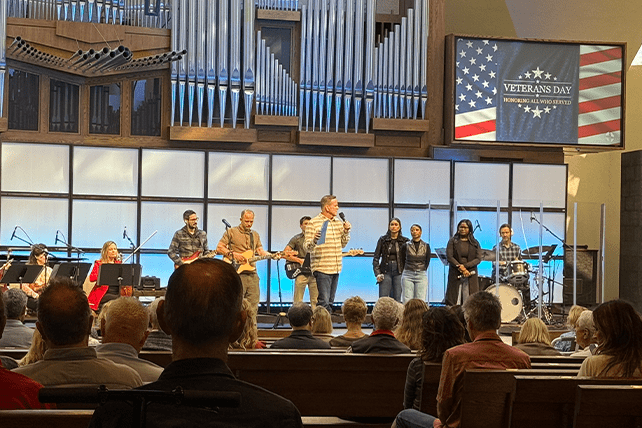
Another example of creativity preceded my sermon on Philippians 3:7-16, which was part of the church’s sermon series on “Joy.” To bring the text to the forefront, the creative institute worked with a professional actor, Mack Hubbard, who recited the sermon text as a monologue in the character of the Apostle Paul.
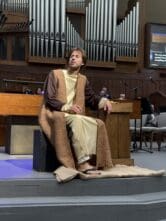
As it said in the church’s annual report:
Mack’s nuanced and passionate performances brought a sense of urgency to Paul’s writings and made the apostle’s joy in Christ palpable.
Not only were those in the pews inspired, but Mack’s own faith deepened throughout the process of memorizing and studying the Bible. “Paul and other characters from the Bible, they were as real as you and me,” he said. “They lived, and they had the same questions about God. Being able to step into the mindset of Paul makes it so real.”
I enjoyed getting to experience the impact of this creative initiative firsthand.
Takeaways for Church Leaders
As pastors and church leaders, we can learn some things from this visit to St. Andrew’s. Specifically, we are reminded that we must discern the context of both our church’s internal community and the community we are called to serve. We should develop our ministry strategy in light of these realities, even as we align with the core, non-negotiable elements of a biblical doctrine of the church, or ecclesiology.
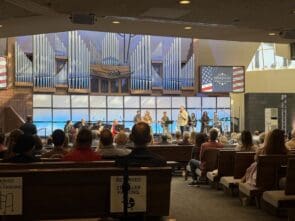
We need more ecclesiology for our moment, not less, and part of a missional ecclesiology will account for the needs of the congregation and community for the sake of the gospel. For St. Andrew’s, as for many others, a two-service strategy can contextualize to and within the community where the church lives and serves.
Whether in church planting situations, revitalizations, or smaller or larger congregations, we all must do the work of seeking to show and share the love of Jesus where we actually are. It might be multiple worship services, it might be applying the gospel through the arts, or it might be another form of contextual ministry.
It’s not a question of if we will do these things, but if we will do them effectively, fruitfully, and faithfully, for the good of our neighbors and the glory of God.