This shift requires some context. Universalism taught that all people would ultimately be saved—a theology that Baptist churches then and now have rejected as contradicting Scripture’s teaching on judgment and salvation through Christ alone. Whatever Dodge’s reasons for the change, his new ministry would have significant consequences for New London.
During his time as pastor, Dodge helped establish Universalism as a presence in the city. He preached, he led, he built a congregation. And though Dodge himself eventually moved on, the seeds he planted grew.
By the 1830s, Universalist ideas had begun infiltrating New London’s Baptist congregations.
When Theology Divides a Church
The First Baptist Church of New London, organized in 1804, found itself in crisis.6 Members who had worshiped together for decades now disagreed on fundamental questions: Is salvation through Christ alone, or will all eventually be saved? Is there eternal judgment, or does God’s love override justice?
These weren’t minor disagreements about worship style or building plans. These were questions about the very nature of the gospel.
A Baptist pastor named Jabez Swan led a revival in 1842 that brought the issue to a head. The result: the Universalists left to form their own congregation.7
Now here’s where the story gets interesting.
Building the Tallest Steeple
The Universalists weren’t content to meet quietly in some modest building. They had a statement to make.
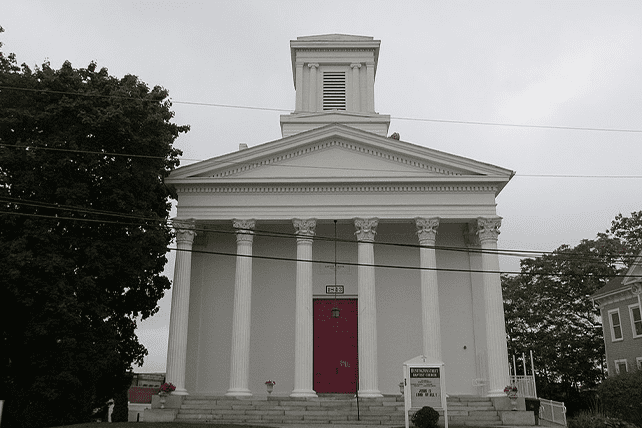
In 1843, they hired John Bishop—a member of their congregation and a skilled builder—to design and construct a church that would dominate New London’s skyline.8 Bishop drew inspiration from Minard LaFever’s influential book “The Beauties of Modern Architecture,” creating a stunning Greek Revival structure with six massive Corinthian columns and a tower that rose higher than any other church in the city.
They built it deliberately: on a granite outcrop on Huntington Street, positioned to overlook the Baptist churches below.9
The message was clear. The Universalists were here to stay.
Or so they thought.
The Building That Changed Hands
The magnificent church nearly bankrupted the small congregation. The cost was crushing. Financial strain combined with dissatisfaction over their pastor’s preaching, and within six years, the Universalists could no longer hold on.10
In 1849, they sold the building for $12,000.11
The buyer? A new Baptist congregation of 185 members who had separated from First Baptist Church—led by the same Rev. Jabez Swan who had led the revival that split them off seven years earlier.12
The historical record includes a remarkable detail: When the Universalists were building in 1842, Swan had reportedly told them, “Now plan and build a good house. Build no small thing for the Lord. The Baptists shall yet possess the house, and I expect to stand in its pulpit and preach.”13
On March 29, 1849, Swan mounted that pulpit and preached the dedication sermon.
What the Universalists built to advance their theology became a pulpit for proclaiming the biblical gospel. The building with the tallest steeple in New London—built to declare Universalist prominence—became Huntington Street Baptist Church.
6 “Danbury Baptist Association to Thomas Jefferson.”
7 “Huntington Street Baptist Church,” Wikipedia, accessed December 26, 2025, https://en.wikipedia.org/wiki/Huntington_Street_Baptist_Church.
8 “First Baptist Church, New London (1856),” Historic Buildings of Connecticut, accessed December 26, 2025, https://historicbuildingsct.com/first-baptist-church-new-london-1856/.
9 “Huntington Street Baptist Church,” Wikipedia.
10 Ibid.
11 “NRHP nomination for Huntington Street Baptist Church,” National Park Service, accessed December 26, 2025.
12 Ibid.