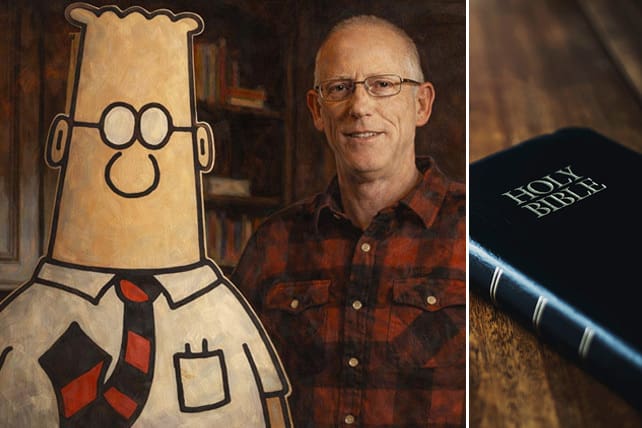
Scott Adams—best known as the creator of the beloved comic strip Dilbert—was one of the most influential and controversial cartoonists of his generation. With a career that spanned decades, Adams became a cultural figure far beyond the comic pages. His work, his public statements, and his final reflections on life and faith have kept his legacy in the conversation even after his untimely death at age 68.
Scott Adams: Early Life and Rise to Fame
Scott Adams was born on June 8, 1957, in Windham, New York. From an early age he showed a talent for drawing and satire, traits that would later define his most iconic work. After studying economics and working in various corporate positions, Adams drew inspiration from his experiences in the workforce to create Dilbert—a comic strip that humorously and sharply critiqued office culture.
The comic strip debuted in April 1989 and quickly resonated with readers around the world for its razor‑sharp observations about corporate life, bureaucracy, and management missteps. By the mid-1990s, Dilbert appeared in over 800 newspapers, later expanding to about 2,000 worldwide and 25 languages at its peak. Adams won the National Cartoonists Society’s Reuben Award in 1997 for Outstanding Cartoonist. The strip spawned bestselling books like The Dilbert Principle (1996), which argued that companies promote incompetent people to management to minimize damage. Dilbert became a staple of office walls, coffee breaks, and pop‑culture references. Its success helped establish Adams as a voice for millions of workers who saw their own frustrations reflected in his characters.
Strips often highlighted the “Dilbert Principle,” micromanagement, pointless meetings, and technology gone wrong, capturing the Kafkaesque side of white-collar life. Recurring gags involved Dilbert’s failed inventions, Wally’s laziness, and Alice’s underappreciated brilliance. Adams credited personal techniques like daily affirmations for his success.
RELATED: ‘Dilbert’ Creator Scott Adams, Battling Terminal Cancer, Plans To Convert to Christianity
In addition to Dilbert, Adams became a bestselling author with books like How to Fail at Almost Everything and Still Win Big, Win Bigly, and Loserthink. He expanded his influence far beyond comics into public speaking, social commentary, and internet media, attracting a large and loyal online following.
Controversies That Defined the Late Years
Despite his professional success, Adams became a highly controversial figure in the later years of his life—especially after 2020 and the COVID-19 pandemic. He frequently used his platforms to share scathing political commentary, sometimes straying far from the world of comics into highly charged cultural debates.
One of the most consequential controversies occurred in 2023 when Dilbert was dropped from many newspaper syndications following remarks Adams made about race and a political poll. In that instance, Adams commented on a poll suggesting that only a certain percentage of Black Americans agreed with the statement “It’s OK to be white,” and he offered statements that many critics deemed racist. Adams also urged white people “to get the hell away from Black people” during his online video program and went on to label Black people a “hate group.” Newspapers across the country severed ties with the comic strip in response, drastically reducing its mainstream presence.
Adams also became known for voicing strong, at times confrontational, opinions on a range of political topics. He was an early supporter of Donald Trump’s presidential candidacy and remained allied with many conservative causes as a commentator. His daily podcast, Real Coffee With Scott Adams, continued until shortly before his death and drew both praise and criticism for its unfiltered discussions of current events.
These controversies ultimately shaped the public perception of Adams. For some, he was a brilliant provocateur willing to challenge conventional thinking; for others, his statements and tone alienated former fans and cemented his reputation as a divisive influence.
Scott Adams’s Illness and Public Struggles
In May 2025, Adams publicly revealed that he had been diagnosed with an aggressive form of metastatic prostate cancer that had spread to his bones. The announcement shocked fans and followers, many of whom were unaware of his serious health struggles. Over the ensuing months, Adams documented his illness and its effects, drawing supporters and critics alike into conversations about life, mortality, and meaning.