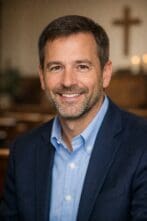
Content-wise, Live Free is where Howerton most clearly differentiates himself. Episodes regularly engage topics that extend beyond theology into cultural and political territory. For example, recent episodes have explored questions like whether America should be considered a “Christian nation,” engaging both biblical interpretation and contemporary debates about nationalism. Other episodes tackle cultural flashpoints more directly, such as critiques of media and entertainment, including discussions framing perceived ideological messaging in platforms like Netflix.
He has also addressed doctrinal and theological controversies circulating in popular Christian discourse, such as debates over hell and annihilationism in response to comments by public figures. In other episodes, he has focused on social trends affecting younger generations, including discussions about masculinity, loneliness, and the challenges facing young men in modern culture. Additional topics have ranged widely, from questions about Islam’s role in American society to speculative cultural conversations about aliens and spiritual warfare.
Taken together, these topics reveal a consistent editorial approach: interpret current cultural conversations through a conservative evangelical theological lens, often emphasizing clarity, conviction, and contrast with prevailing cultural narratives. This positioning helps explain both his appeal and his controversy. For listeners seeking direct engagement with contentious issues, his content offers a steady stream of analysis and application. For critics, the same content can feel like a blending of theology with ideological or political framing.
By the same token, his approach reflects a broader shift in evangelical media. Podcasting has lowered the barrier for pastors to build national platforms, but it has also rewarded those who can consistently engage timely, high-interest topics.
Josh Howerton is not yet a dominant figure in terms of raw audience size, but he is part of a rising category of leaders who are leveraging podcasting not just for teaching, but for influence. In that way, he represents a new kind of evangelical media figure: a pastor whose influence is built not only on sermons, but on a steady stream of content interpreting the world in real time.
A Voice in Culture Wars
As his platform has grown, so has his willingness to address politically charged topics. On Live Free, Howerton frequently discusses issues such as abortion, gender identity, religious liberty, and public policy. His framing tends to emphasize what he sees as a conflict between historic Christian teaching and modern cultural trends. In these discussions, he often critiques progressive interpretations of Scripture and argues for a more traditionalist reading.
RELATED:Pastor Salary: Should Pastors Make Six Figures?
This approach has resonated with a segment of evangelicals who feel that many churches have avoided uncomfortable cultural conversations. For these listeners, Howerton represents a pastor willing to speak directly and unapologetically. At the same time, his tone and framing have drawn criticism from others within the broader Christian community, who argue that his rhetoric can blur the line between theological conviction and political ideology. Some recent podcast topics have included:
- “What Happens When You Die?”
- “Debunking Progressive Views of the Bible and Slavery”
- “Should Christians Think Differently About Rights and Government?”
- “Christian Nationalism: What Should Believers Believe?”
- “Is President Trump Saved?”
- “What Christians Must Know About Islam in America”
- “Why Young Men Are Lost—and How to Fix It Biblically”
- “Are Aliens Actually Demons?”
Check out Josh Howerton’s Podcast Live Free here.
Increasingly Visible Political Alignment
One of the most debated aspects of Howerton’s public presence is his perceived alignment with conservative political movements, including rhetoric and positions often associated with the modern MAGA movement spearheaded by Donald Trump.
While Howerton does not present himself primarily as a political figure, his commentary has increasingly overlapped with themes common in that space, particularly around nationalism, immigration policy, and critiques of progressive politics.
In one widely discussed sermon, he framed civic participation in theological terms, suggesting that abstaining from voting could be understood as a form of disobedience. The message drew both support and pushback, highlighting the tension around how directly pastors should speak into electoral politics.
He has engaged with political figures and events in ways that signal proximity to conservative evangelical political networks. Appearances, interviews, and discussions tied to national political moments have reinforced the perception among critics that his platform is not merely theological but also politically aligned. Supporters, however, often reject that characterization, arguing that Howerton’s positions are rooted in biblical convictions and not partisan loyalty.
Clarity in a Confusing Moment
Part of Howerton’s appeal lies in his communication style. In an era when many institutional voices are perceived as cautious or ambiguous, he speaks with a level of clarity and certainty, and that resonates with listeners seeking firm answers. His personable teaching often presents issues in binary terms: truth versus error, biblical fidelity versus cultural compromise. He has also been open in blogs and interviews about his struggles with anxiety, doubt, and grief, offering a transparency many public figures shy from. He described experiencing recurrent anxiety attacks in 2019 just as he was stepping into the role of lead pastor at Lakepointe.