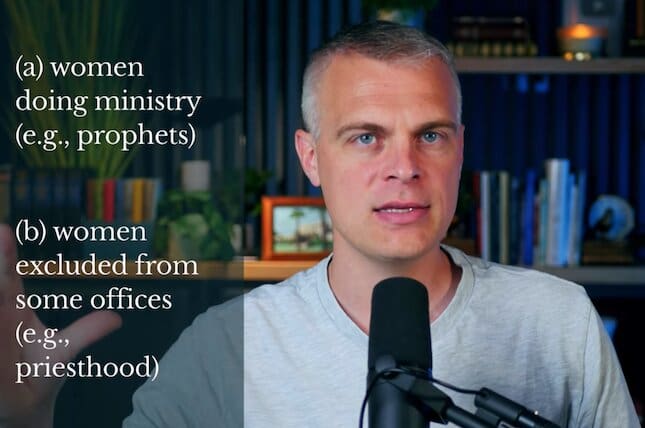
Regarding the Bible’s position on women in leadership, Ortlund said that the Bible shows “that women are involved in ministry and even spiritual influence and leadership in so many ways. Sometimes people are surprised by this, and it does challenge some of the more restrictive views.”
For example, there are female prophetesses in the Old Testament, and in the New Testament, men and women both have the gift of prophecy. “In 1 Corinthians 11, Paul gives instruction for how women should pray and prophesy, apparently in the gathered assembly, and that is just prophecy,” said Ortlund, “and there are so many other wonderful gifts that God gives to women. And by the way, those on the more traditional side of this issue should be enthusiastic about this.”
RELATED: Does the Early Old Testament Talk About the Afterlife? Gavin Ortlund Shares His Thoughts
“This shouldn’t come across as a concession,” he said. “We should delight and glory in the gifts that God gives to all members of the body of Christ, men and women, children, young and old.”
However, the entire Bible gives a picture of “lots of gifting and ministry going on among men and women while at the same time there is an ongoing office that God institutes of leadership and governance and teaching that is reserved for men,” said Ortlund.
For example, in the Old Testament, only men could serve as Levitical priests. In the New Testament, Jesus only calls men as his apostles. “Sometimes it’s suggested that he was just sort of accommodating to the culture there,” Ortlund said, “but we’ve already seen Jesus didn’t accommodate to first century Jewish norms. He was very willing to challenge them. He elevated women in their status in that society. And yet he chose 12 men.”
There is also “very clear teaching in New Testament epistles that [seems] to restrict certain roles in the church to men,” Ortlund continued, mentioning 1 Timothy 2. Verses 11-14 say:
A woman should learn in quietness and full submission. I do not permit a woman to teach or to assume authority over a man; she must be quiet. For Adam was formed first, then Eve. And Adam was not the one deceived; it was the woman who was deceived and became a sinner.
Another example is 1 Timothy 3, in which Paul assumes an “overseer” is a male.
Ortlund addressed an apparent contradiction between 1 Corinthians 11, where Paul gives instruction for how women should pray and prophesy, and 1 Corinthians 14 where Paul says, “Women should remain silent in the churches. They are not allowed to speak, but must be in submission, as the law says.”
“Which is it? You know, surely if they’re praying and prophesying, they’re not silent,” Ortlund said. “So how do we understand this?”