
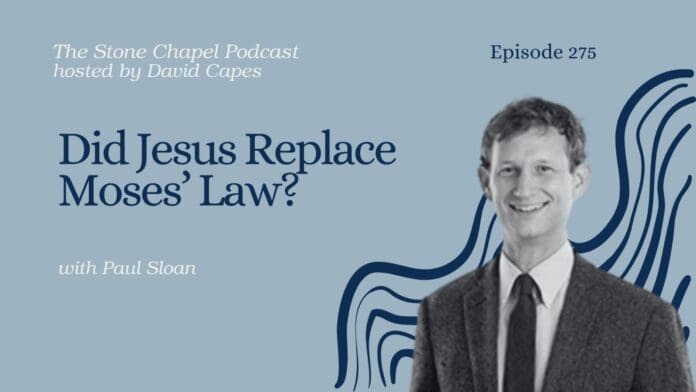
David Capes
I have a rabbi friend in Jerusalem. His Church is on Narciss Street there in Jerusalem, and he says that Jesus never said anything that wasn’t already said in the law.
Paul Sloan
I agree. E.P. Sanders wrote an essay called The Question of Uniqueness in the Teaching of Jesus. And he says, there’s a lot of great and wonderful and distinctive things about Jesus. What was not unique about Jesus was his moral instruction. Everything that Jesus says in his moral instruction can be found in Jewish texts that predate Him or are contemporary with him. And I agree with that. It’s just objectively the case. You can put up all the texts and say, this position here that you ought not lust after a woman in your heart and your eyes, is there in Jubilees.
David Capes
And they’re in the 10 Commandments.
Paul Sloan
They’re in the 10 Commandments, yes.
David Capes
To fulfill the law. I’ve not come to abolish, but I’ve come to fill-full the law.
Paul Sloan
Yes. One thing he says in 5:17 is, do not consider that I’ve come to abolish the law or the prophets but I have come to fulfill. I think the verb still governs both the law and the prophets. But the point there is that people have heard that word fulfill and have taken that to signal that this is Matthew’s typical use of fulfillment language. Because elsewhere in Matthew, he’ll quote a prophecy and say this was done in order to fulfill what was written in Isaiah, Jeremiah, Daniel, whatever. And so they think that that’s the thing going on here with the fulfill idea.
And my point is, no, I think the law and the prophets are often used in Jewish texts to refer to basically what the law teaches and how the prophets have also taught that or exposited it. So, the law itself says, don’t work on the Sabbath. And then in the prophetic text, like Jeremiah, you get prophetic instruction about how to keep Sabbath properly so that the law and the prophets hang together. In fact, even Jesus himself says, when asked about the greatest commandment, love the Lord your God and love your neighbor as yourself. And on these two commandments, hang the law and the prophets. In other words, by law and prophets. I think he’s talking about the divine will as revealed and exposited in Torah and the prophet.
David Capes
Which would include what we would call books of history as Protestants. Things like Joshua, Judges, one or two Kings, Samuel.
Paul Sloan
That’s right. When he’s saying, I’ve come to fulfill that, I think once you’ve got the notion that law and prophets can effectively mean the law or the commandments in it, well then once you’re coupling the verb fulfill with that thing, with the law. It basically means to do or to keep, to effectively do them. I think Jesus is saying, I’m here not to abolish but to do these things and to teach others how to do them as well.
David Capes
Right. At the very end of that, he says to His disciples, unless your righteousness exceeds that of the scribes and the Pharisees, you will not enter the Kingdom of Heavens. I’ve used this phrase, and I’m sure you have, this greater righteousness, desire. Excessive righteousness. So righteousness becomes very key to the sermon and it becomes very key to the teachings of Jesus. How does that connect with the law, this notion of righteousness?
Paul Sloan
I think righteousness is the quality of the person who is in conformity with the given standard. If you are keeping the standard, you are righteous. The person who has righteousness is a person who is fulfilling the standard as revealed in the Torah or the prophets or whatever. The question is, what does he mean that your righteousness has to exceed that of the Pharisees? And there people have gotten the notion that the Pharisees were these super righteous people who kept the law so scrupulously. So, for Jesus to be calling them above that is to be calling them to this otherworldly, impossible standard.
Now, I do want to be clear. I do think Jesus is calling His people to a high standard, and that it’s the moral ideal. The only thing I’d want to correct in that description is that I don’t think that Jesus thinks it’s an impossible standard. When he’s saying your righteous must exceed that of the Pharisees, he doesn’t think that’s impossible. Because in the Gospels, Jesus thinks the Pharisees aren’t actually righteous. He thinks they’re not actually law keepers. That’s his explicit criticism of the Pharisees throughout the Gospels; is they actually don’t keep the law.
And so in order to attain to the righteousness that exceeds the Pharisees, just means you need to be a law keeper. Because they’re not law keepers according to Jesus. And the way you do that, according to the Gospels, is living by Jesus’ instruction of it.
David Capes
You talked about Jesus’ harshness to the Pharisees and others as well. One of the things I think you point out that I think is very much a part of the texture of the Gospels, is that Jesus is part of an intra Jewish debate. He’s not just debating outsiders. He’s debating people inside, and he’s trying to show them what God’s will looks like when it’s done on earth as it is in heaven.
Paul Sloan
That’s right. And the point there is that it’s easy. If you’re looking at Jesus and already have in your mind the notion that he represents Christianity, and you see that he’s criticizing the Pharisees, or his Jewish interlocutors who represent Judaism. Well, now you’ve turned what in the Gospels is actually an intramural debate into an ‘against Judaism’ debate. Jesus is against Judaism. Jesus against Judaism, that sort of idea.
Whereas I’m saying, no, it’s important that you recognize Jesus is Jewish and is operating within the shared narrative assumptions that his other Jewish people and the Pharisees have. Namely that this is the law that God’s given us, and we all want to interpret it and do it rightly. And so that when Jesus is teaching, the Gospels are presenting Jesus as the one with this authoritative interpretation of what it means to be a law keeper. And that his interpretation is sometimes at odds with the Pharisaic interpretation. Which then contextualizes his criticism of the Pharisees not as this anti-Judaism thing, but as intramural debate against other Jewish interlocutors who have different answers about what it means to be a law keeper. And so, the Gospels are presenting Jesus as the one with the authoritative answer.
David Capes
The one who knows the law, who knows it and does it. You use this word “herald” a lot. The idea is the herald of the restoration. That this restoration is coming and that we’ve got to get ready for it. And we do that by repenting, turning and keeping the law.
Paul Sloan
That’s right. Keeping the requirements that God has given us by which we can mark ourselves out as people who are participating in that restoration.
David Capes
My rabbi friend often makes a statement that has helped me. In Judaism, “the law is not the means of salvation, it is the presence of salvation.” I always thought that was a very helpful way of rethinking what the law means.
Paul Sloan
Yes, I think that is a helpful way of thinking about it, and it also helps explain within the New Testament, there might be some who do have different ideas about what the Torah is, or how it functions in God’s economy. Is it simply the thing that reveals the righteous will, but that you need the Spirit in order to be able to keep? Or is the Torah itself actually the God-given technology by which you become obedient? Those are different ways of talking about law. But as you said, you can still, though, talk about the law as God’s revelation. Here’s what it means to live rightly before me and with each other.
David Capes
And we can have that relationship now together. Paul Sloan, this is a great book. Thank you. “Jesus and the Law of Moses.” I wish we had about another hour talking about the subtitle, “The Gospels and The Restoration of Israel Within First Century Judaism.” We didn’t get a chance to talk about Paul and the law. We’ll take that up another time. Thanks again.
Paul Sloan
I’d love to. Thanks for having me.
Transcribed by https://otter.ai
