Written by Jane Fox, in association with the Lausanne North American ISM Strategy Group.
Have you ever wondered how to connect more deeply with people from other cultures? At first, we learn how they got to our location, why they came, and what they are pursuing. Over time with them, we may learn about their families, cultural practices and values, or their religion. Sometimes we may discover their personal stories of overcoming challenges and finding solutions. When we share stories, we develop empathy and hence a greater connection with each other.
There are many ways we share stories. We might read books and develop empathy with the characters we read about, either fictional or true. With friends, it is easy to watch a movie or attend a musical, theater, or dance performance. Afterward, we connect over our shared experiences and observations of characters and plot. All the while, our empathy muscles are strengthened as we listen and ask thoughtful questions. As a result, our interpersonal relationships will grow.
RELATED: The Scandal of Evangelical Empathy: How Did We Even Get Here?
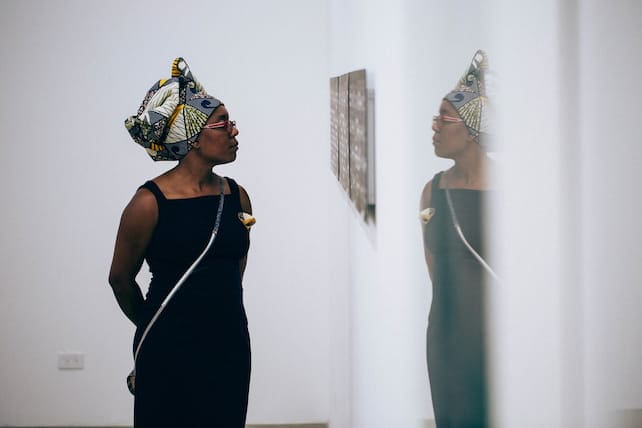
Looking at art together is another wonderful way to share stories. Art tells a story, though it may not be readily understood without some thought, contemplation, and investigation. When we do this with another person, we not only learn about the art but the other person as well. What do they consider beautiful? How do they connect with another person’s story?
Lady Bird Johnson said, “Art is the window to man’s soul. Without it, he would never be able to see beyond his immediate world; nor could the world see the man within.” Could sharing art help us grow in our mutual understanding, compassion, and empathy toward each other and the World?
In this article, we will explore how a work of art tells several stories and how these stories create empathy between people who explore the stories together.
Remember: Stories + Empathy = Connection
So, where can you find art to explore with your friends?
There is more readily available art than what we might expect. Notice the public art surrounding you, such as architecture, gardens, fountains, sculptures, murals, graffiti, art festivals, and markets. Galleries and museums often hold vast treasures from locations around the world. Be intentional about going into these spaces. Once inside, look over the layout of the museum and let your interest be your guide as to where to begin. When you enter a room, scan it for something that looks inviting. If you are at a museum with your international friend, why not start with what your friend is most interested in? Is it ancient art, Asian art, African art, modern art, or medieval art? As you listen to your friend and to the art you observe, you will learn about what is important to your friend and the story portrayed in the art.
Art tells many stories. Stories build empathy and connection.
So how does one go about discovering the story in the art we are looking at?
- Begin by asking questions about what you see. Describe the art, the colors, the figures, the materials, and the design. That is the first and most obvious story.
- Next, tell what you think is going on in the piece. Is there a story the artist is trying to draw your attention to?
- Read the attribution which names the artist, location, and date. In some museums, they have recordings that explain the artwork. You can always look up some more details of the artist or historic period. This investigation may reveal another story.
- The fourth story has to do with empathy and connection. Ask each other what attracts or repulses you about this piece of art. Does it have anything to say about your personal story? Do you find hope, despair, or faith in this work?
Let’s say that you are in the Metropolitan Museum of Art in NYC, and you come across this piece of clothing.
1. Start by naming the colors in the design: orange, yellow, and black. Next, consider the design of the clothing: a one-piece garment with large cut-outs for arms and pant-like openings for legs. This is the first story.
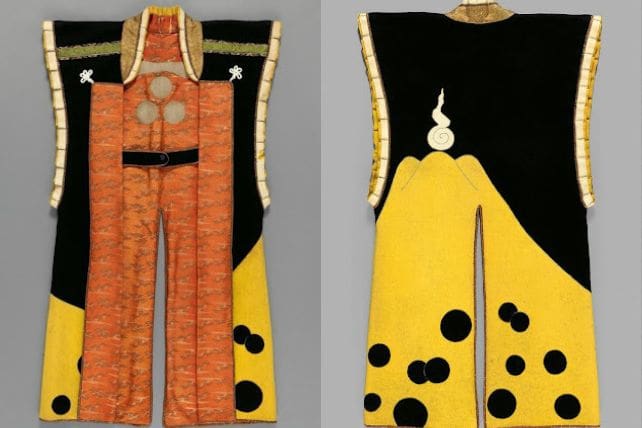
2. The second story is what is going on in the garment. The back seems to be the image of a mountain with a curious symbol resting at the top. What is the mountain? Could it be Mt. Fuji? What are the black circles midway down the mountain image? On the front, you may ask is there a significance about the color orange and how they placed it on the garment?
3. You might want to do some investigating to fully comprehend the story. Perhaps reading the comments on the Met website will help (https://www.metmuseum.org/art/collection/search/669042).
If you did further research, you might discover what a Jinbaori and surcoat are, who wore such a coat, and why (https://www.britishmuseum.org/collection/object/A_1897-0318- 6#:~:text=The%20jinbaori%20was%20originally%20a,perhaps%20surprisingly%2C%20an%20 archery%20target).