What are church rights under the laws? Following the disruption of worship at a Southern Baptist Convention (SBC) church in St. Paul, Minnesota, yesterday (Jan. 18), experts are advising pastors and lay leaders about the legal rights of churches. With protesters claiming the right to free speech, churches should understand their own protections under federal and state law.
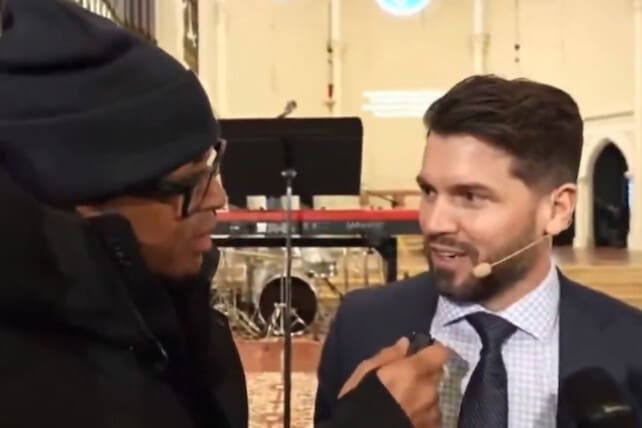
On Sunday, a group of people protesting recent operations by U.S. Immigration and Custom Enforcement (ICE) entered the sanctuary of Cities Church and disrupted worship. According to reports, the group claimed that one of the church pastors has links to ICE.
Some protesters chanted the name of Renee Good, the motorist who was shot and killed by ICE officer Jonathan Ross on Jan. 7. Videos from Sunday’s incident at Cities Church show some worshipers leaving the area, while others comforted frightened children.
Here’s what happened inside Cities Church today. Look at the terrified child being comforted by his father at 1:05.
If the FACE Act isn’t enforced against these lawless radicals, then expect for this to continue all over the country.@AAGDhillon pic.twitter.com/uV8Btg1tFX
— Denny Burk (@DennyBurk) January 19, 2026
RELATED: NAMB Calls Anti-ICE Disruption of Minnesota Church ‘Lawless Harassment’
The U.S. Department of Homeland Security, which oversees ICE, wrote that “agitators” are now “targeting churches.” Administration officials continue to call out Democratic leaders in Minnesota, accusing them of interfering with federal operations.
Assistant Attorney General Harmeet Dhillon indicated that the Justice Department’s Civil Rights Division is “investigating the potential violations of the federal FACE Act by these people desecrating a house of worship and interfering with Christian worshippers.” U.S. Attorney General Pam Bondi said she directed such an investigation, adding, “Any violation of federal law will be prosecuted.”
The @CivilRights is investigating the potential violations of the federal FACE Act by these people desecrating a house of worship and interfering with Christian worshippers. @AGPamBondi https://t.co/uZBBv1iuuH
— AAGHarmeetDhillon (@AAGDhillon) January 18, 2026
Referencing “the despicable incident” in St. Paul, White House Press Secretary Karoline Leavitt wrote that “President Trump will not tolerate the intimidation and harassment of Christians in their sacred places of worship.”
Church Rights Explainer for Pastors
Kevin Ezell, president of the SBC’s North American Mission Board, decried the “lawlessness” of Sunday’s protest in St. Paul, saying it is “shocking and beyond unacceptable…to violate the sanctity of a worship service this way.” Ezell, who thanked federal officials for investigating the incident at Cities Church, added, “Churches must be defended against attacks like this.”
Both federal and state laws protect church worship services from outside interference. The FACE Act that Assistant Attorney General Harmeet Dhillon referenced is 1994 legislation that protects “Freedom of Access to Clinic Entrances.” Although the name calls to mind abortion clinics, the law also safeguards religious freedom at places of worship.
The Justice Department has filed at least 15 FACE-related actions in recent years. Violators are subject to civil penalties.
RELATED: Anti-ICE Protesters Disrupt Sunday Worship at SBC Church in Minnesota, Prompting DOJ Investigation
Most states also have legislation making it a crime to willfully and purposefully obstruct or disrupt church worship services. In Minnesota, for example, it is a misdemeanor to “intentionally and physically [obstruct] any individual’s access to or egress from a religious establishment.”
Because churches are private property, individual congregations are permitted to set and enforce conduct rules, remove violators, and contact law enforcement for assistance. As ethics and public policy professor Andrew Walker noted, “There is no constitutional right to protest a private religious assembly.”
In the 1972 case Lloyd Corp. v. Tanner, the U.S. Supreme Court ruled that just because an establishment is open to the public does not mean it automatically becomes a public forum. Forty years later, in Hosanna-Tabor Evangelical Lutheran Church and School v. EEOC, the high court again emphasized the autonomy of religious institutions.
However, peaceful protests are permitted outside a church, on public property such as a sidewalk. The conduct of protesters becomes illegal when they block church access, interfere with worship proceedings, or threaten pastors or worshipers.
Church leaders and volunteers are allowed to ask any disruptive individuals to leave church property. Experts also recommend contacting local law enforcement to document such an incident and to help de-escalate tensions.
Following the disruption of worship at a Southern Baptist Convention (SBC) church in St. Paul, Minnesota, yesterday (Jan. 18), experts are advising pastors and lay leaders about the legal rights of churches.Click to Post