Nobody wakes up one Sunday and decides their church is dying. It doesn’t happen that way. It happens slowly, in the silences between the sermons, in the conversations nobody wants to start, in the metrics nobody wants to pull up on a screen.
The church that’s dying isn’t always the one with a half-empty parking lot. Sometimes it’s the church that still fills its seats on Easter, still runs its programs, still smiles through announcements — but has quietly lost the thing that made it a church in the first place.
For the first time in decades, in-person worship attendance at the median U.S. congregation increased in 2025, though almost half of churches (46%) still reported an attendance decline of at least 5% from 2020 to 2025.
According to Thom Rainer and Lifeway Research, seven out of ten churches in America are currently in decline.
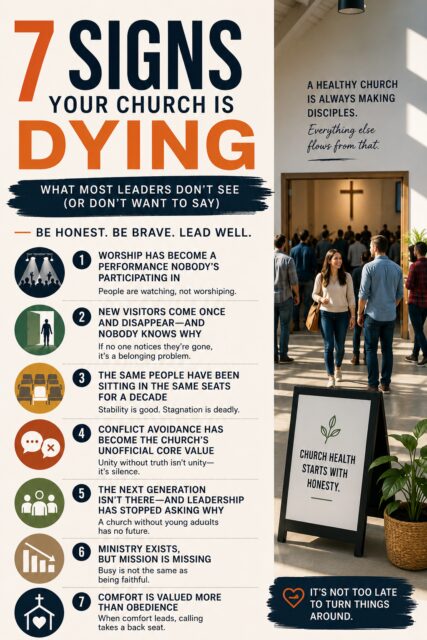
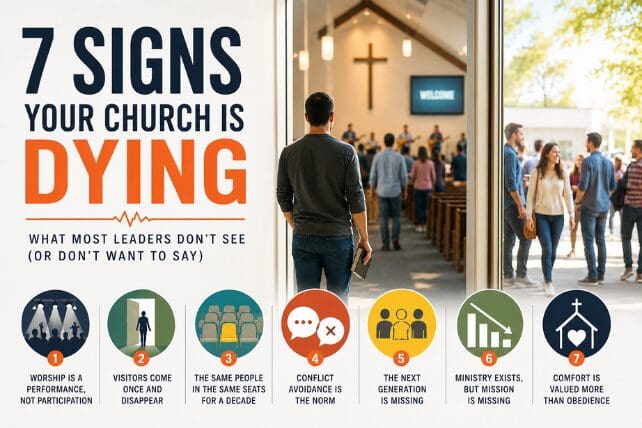
These are the seven signs most church leaders either don’t see or don’t want to say out loud. Read them honestly. If three or more describe your church, you don’t have a program problem. You have a foundation problem.
1. Worship Has Become a Performance Nobody’s Participating In
You can feel it the moment it happens. The band is tight. The lights are perfect. The IMAG screens are crisp. And the congregation is watching.
Not singing. Watching.
When worship becomes a concert people attend rather than a corporate expression of faith they participate in, something has shifted at the root. The problem isn’t the style of music. The problem is that somewhere along the way, excellence became the goal instead of encounter — and the congregation quietly concluded that their voice wasn’t needed.
This sign is dangerous precisely because it’s easy to misread. Attendance is up. Production quality is high. People seem engaged. But engagement isn’t participation, and a church full of observers is not a church in worship — it’s an audience at a Christian event.
“A church full of observers is not a church in worship. It’s an audience at a Christian event.”
If your worship leader is the only person in the room whose voice you can hear, that is not a technical problem. It is a spiritual one.
2. New Visitors Come Once and Disappear — and Nobody Knows Why
Every church tracks first-time guests. Very few churches honestly track what happens to them in the thirty days after.
If your church regularly sees first-time guests but struggles to explain where they go, you likely have one of two problems: your church is not as welcoming as it feels from the inside, or the experience you’re offering isn’t compelling enough to return to on a normal Sunday. Both are serious. Neither is solved by a better follow-up email sequence.
RELATED: Why People Leave Church: Here Are the REAL Reasons
The deeper issue is what the dropout rate reveals about the church’s actual culture. Healthy churches retain guests at a meaningful rate not because of systems, but because people who visit encounter genuine community — people who follow up not because someone put it on a task list, but because they actually wanted to see that person again.
Honest question to sit with: If a first-time guest visited your church last Sunday and didn’t return, would anyone on your staff or in your congregation actually notice they were gone?
If the answer is probably not, that’s not a follow-up problem. That’s a belonging problem.
3. The Same People Have Been Sitting in the Same Seats for a Decade
Stability is not the same thing as health. A church can be deeply stable and deeply stagnant at exactly the same time.
When the same 60 percent of seats have been occupied by the same people for three, five, or ten years — with no meaningful new growth, no new faces becoming regulars, no new voices being integrated into leadership — the church has stopped being a living organism and started being a social club with a liturgy.
RELATED: The Real Reason Churches Are in Decline
This sign is the one most pastors know about and least want to address, because addressing it means having an honest conversation with the people who have been most faithful. Nobody wants to tell their longest-tenured members that their comfort may be part of the problem. But comfortable churches are not growing churches, and churches that have stopped growing have, functionally, started dying — because bodies that aren’t growing are decaying.
RELATED: 7 Common Reasons Churches Have a Dramatic Decline in Attendance
The question isn’t whether the people in those seats are good people. They almost certainly are. The question is whether the culture those seats represent is making it possible for new people to find a place to belong.
4. Conflict Avoidance Has Become the Church’s Unofficial Core Value
Every church says it values community, authenticity, and biblical truth. But in the average American church, there is one value that quietly overrides all of the others: don’t rock the boat.
You can identify this church by its silences. The elder board meeting where everyone agrees too quickly. The pastoral candidate everyone has concerns about but nobody voices. The program that stopped working two years ago that nobody has been willing to sunset because the person who started it still attends. The theological drift that a few leaders have noticed but nobody has been willing to name because it might cause a split.
Conflict avoidance masquerades as unity. It isn’t. Biblical unity is forged through honest engagement with hard things. Conflict avoidance is just peace-keeping — and you cannot build a healthy church on peace-keeping. You build it on truth-telling.
“Conflict avoidance masquerades as unity. But you cannot build a healthy church on peace-keeping.”
Churches that cannot name their problems cannot solve them. And churches that cannot solve their problems are not declining slowly — they are declining on a schedule.