When Lent ended last year, Bryant announced the Target Fast would continue as a broader boycott, saying Target had only agreed to fulfill the $2 billion commitment but not the other demands. The pastor credited the campaign with reducing Target’s foot traffic and contributing to declining stock performance; the company has acknowledged that boycotts have affected its sales.
RELATED: Pastor Jamal Bryant Says ‘Target Fast’ Is Now a ‘Full Out Boycott’: ‘We Ain’t Going Back in There’
In August, Target announced that Chief Operating Officer Michael Fiddelke would be replacing Brian Cornell as chief executive officer effective Feb. 1.
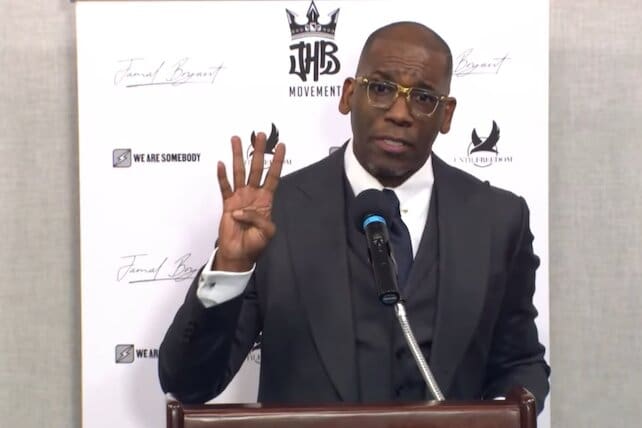
During the press conference, Bryant thanked 300,000 people who registered to be part of the Target Fast, which lasted for nearly 400 days. The pastor said people didn’t think the boycott would work because a “whole generation has not seen an effective boycott.”
Bryant said that Target had seen a $12 billion decline in market valuation and three consecutive quarters without profit, which he attributed to the boycott. However, a March 3 press release from Target states that while the company’s annual sales and comparable store sales declined, the company remained profitable and expects sales to grow again in 2026.
During Wednesday’s press conference, Bryant reviewed four demands the campaign made of Target and how the company responded. He said Target completed 97% of the $2 billion investment pledge and even exceeded it by giving an extra $100 million in grants and scholarships to Black-led organizations. The remaining amount should be completed by Easter. The investment includes partnerships with Black-owned brands, media outlets, and suppliers.
Bryant said Target has expanded support for HBCUs, including giving $10 million to Pensole Lewis College of Business and Design in Detroit, $18 million to the United Negro College Fund, and $8 million to the Target Scholars Program. He also said Target plans to partner with an HBCU business program to help students develop business skills, prepare for interviews, and integrate into biased workspaces.
The pastor further said that Target has taken steps related to diversity. It has implemented a “Belonging” program aimed at expanding opportunities for minorities and women in the company. And according to Bryant, 13% of Target’s board now consists of minorities.