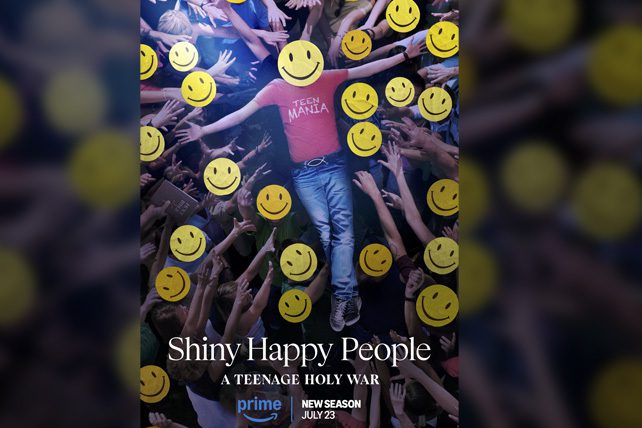
Millions of people had good experiences with Teen Mania, said Luce, and tens of thousands of students who went on mission trips all “returned home safely.” Luce acknowledged that it is impossible that everyone who encountered Teen Mania had a positive experience but said the “overwhelming majority” of people’s encounters with the ministry were good.
He and his wife, Katie, took “seriously any and every negative comment to see how we can approve [sic] and get better.”
“Even several of those that were interviewed for the documentary have been engaged personally over the years,” said Luce, “asking for forgiveness asking what could be done to make it right.”
Luce said the number of people with negative stories who were featured in “Shiny Happy People” should have reflected the actual percentage of people who had negative experiences with Teen Mania. Likewise, he believes the producers should have featured people who had positive stories to accurately reflect the positive experiences many had.
Part of the docuseries features Phil Boltz telling the story of how, when he was a student involved with Teen Mania, he had emergency surgery for appendicitis in rural India. The wound got infected and Boltz developed MRSA. He said he almost lost his life from the experience.
Despite the severity of the situation, Boltz said his parents were not “getting real information” about his condition and were instead told that he was “fine.” Fortunately, a parent volunteer contacted his mother and told her to meet Boltz at the airport with an ambulance so that he could go to the hospital immediately after arriving back in the U.S. Boltz spent weeks in the hospital and had to get a 600-milliliter abscess drained.
In his statement, Luce said Teen Mania leaders took great care to ensure the safety of students who went on mission trips, and he mentioned what had happened to Boltz. “When traveling overseas, there are definitely [the] possibility of medical emergencies [as] in the case of Phil boltz [sic] and others,” Luce said. “We always acted with the greatest amount of alacrity to get them the best care possible and get them home if needed, and by the grace of God all young people came home to their parents.”
Luce also defended Teen Mania’s LTEs, or “life-transforming events,” and objected to how the docuseries depicted the ministry’s view of martyrdom.
Along with Luce’s statement, TRR included a separate email in which Luce addressed the account of Cindy Mallette. In “Shiny Happy People,” Mallette describes how Teen Mania brought her in as comms director to address the PR crisis the organization faced as a result of alumni reports of harm suffered while at the organization.
RELATED: Jinger Duggar Vuolo Explains Why She Chose Not To Appear in ‘Shiny Happy People’
Mallette eventually became convinced that Teen Mania was being dishonest and that alumni who had reported harmful experiences were telling the truth. She became a whistleblower.
One key point of contention between Mallette and Luce pertains to Teen Mania’s former campus, which Mallette said the bank took back due to “foreclosure because of failure to pay.” She said she faced an ethical conflict when Luce wanted to publicly portray the foreclosure as the ministry returning the campus to the bank.
“When we had need of an outside [PR] firm to write some of our press releases,” said Luce in his email, “Cindy got her feelings hurt and began to take advantage of partial information (since she was not in the leadership team she did not have full access), and leak to outside half truths even as she took a salary from teen mania [sic].”
“They mentioned in passing that the technical term for what we agreed to is called a ‘friendly foreclosure’ even though we were not foreclosed upon,” Luce said. “We chose to describe in the press release what actually transpired rather than use the phrase ‘friendly foreclosure’ because of the misperception of technical language in banking transactions. Cindy did not like that choice.”