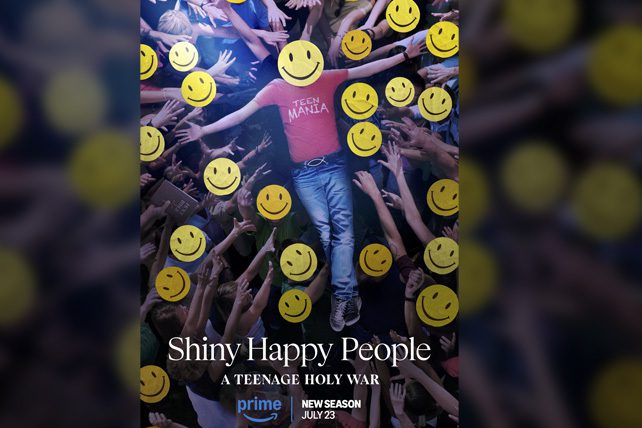
In his statement to Roys about the docuseries, Luce said:
I have no regrets in general regarding the teachings that me or any of my staff at our event [sic] or on campus. [They] were all based in scripture designed [to] help young people understand ancient mysteries of scripture. The only thing I would change is that I’ve [continued] to grow in my understanding of scripture and how Jesus wants us to live And [sic] reflect that in the current writings, books and events.
‘Shiny Happy People’ Participants Respond to Teen Mania Founder Ron Luce
Cindy Mallette posted her own response on Ranfeld’s website to Luce’s statements to TRR. In Mallette’s response, which is separate from the statement the other six “Shiny Happy People” participants signed, Mallette said that Luce “grossly mischaracterized the facts around my efforts to tell the truth about Teen Mania’s financial situation, after he first used me to spread a lie.” Mallette countered Luce’s suggestion that her information was inadequate because she had limited access to leadership.
“All of the information I received and reported came directly from Teen Mania’s then-CEO Dan McLeod,” said Mallette. “Dan participated in the meetings with the bank to come to the ‘friendly foreclosure’ agreement, and Dan showed me the bank statements showing the campus was in default of its mortgage.”
In the other statement, Boltz, Ranfeld, Durr, Rocca, Saum, and Wright list several objections to Luce’s comments to TRR, including the claim that all Teen Mania missionaries returned home safely. “We are familiar with stories of missionaries who were severely injured on their trips and did not ‘return home safely,’” they said. “One of us even had a friend who died while he was serving as a Teen Mania missionary in 2007.”
RELATED: Alex Harris: ‘Shiny Happy People’ Is Flawed but Serves the Church
“In fact, we know the stories of multiple accidental deaths during Global Expeditions work. We do not make the claim that any of these deaths were caused by Teen Mania’s negligence,” said the alumni, “but we do challenge Ron’s untruth that every missionary returned home safely.”
Regarding Luce’s reference to Phil Boltz and Luce’s statement that Teen Mania always took the greatest care possible when it came to medical emergencies, the alumni said, “Although we have always carried our own stories of surviving dangerous situations, we have since [the docuseries came out] learned of many other failures of Teen Mania leadership to respond appropriately to medical emergencies.”
“As depicted in the series, Phil Boltz’s serious medical emergency was handled negligently,” said the alumni. “Phil should have been medically evacuated from India, and Teen Mania should have fully disclosed the severity of his condition to his parents.”
The alumni pushed back on Luce’s view that “Shiny Happy People” should have mentioned positive stories from Teen Mania. “We believe that many people had positive, faith-affirming experiences with Teen Mania,” they said. “However, when telling the story of an organization that has caused harm, it is not the storytellers’ obligation to depict all of the positive stories, too.”
“When we read about the abuse of students, athletes, employees, or volunteers at other organizations, do we also need the stories of everyone who wasn’t abused?” they asked. “Of course not. Although knowing percentages would be interesting, it is outside the scope of this project.”
The alumni expressed that they do not believe the docuseries “mocked the organization we once loved. In addition, our stories were fact-checked thoroughly.” The alumni also addressed Luce’s statements about LTEs and how the docuseries depicted martyrdom.
“Teen Mania has had decades to share participants’ positive experiences, and they have actively tried to silence negative ones,” the alumni said as they concluded. “Our critique of Teen Mania is not rooted in anti-Christian bias, but rather, about Teen Mania’s systematic control of its members. In the world Ron Luce built, the ends always justified the means.”