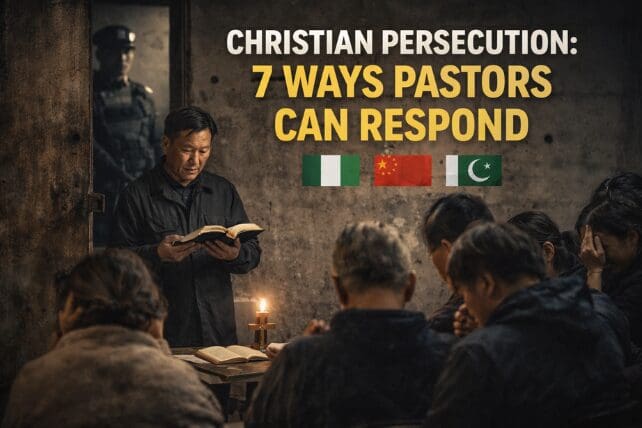
7 Ways Church Leaders Can Respond to Global Persecution
The persecuted church deserves our attention and love. Consider these practical ways to reach out and assist:
1. Pray specifically.
Through prayer, the church participates in the suffering of the global body of Christ. Hebrews 13:3 tells us to “remember those in prison as if you were together with them, and those who are mistreated as if you yourselves were suffering” (emphasis added).
Here are a few ways to build in prayers for the global church:
- In Sunday worship: Name specific countries or regions when you pray, not just “persecuted Christians everywhere.”
- In prayer meetings: Use reports from Open Doors or Voice of the Martyrs to focus on current crises.
- In small groups: Invite groups to “adopt” a persecuted region and pray for it consistently.
Include petitions for protection from violence, strength to persevere, comfort for grieving families, and wisdom for underground church leaders. Also pray that persecutors will repent and be saved.
Action item: Add one country from the World Watch List to name in next Sunday’s pastoral prayer.
2. Preach about suffering.
Have you taught your congregation that suffering for their faith is normal? If not, they might be unprepared, both to support persecuted Christians and to respond well when opposition hits closer to home.
Biblical teachings about persecution run through the Psalms, Prophets, Gospels, and Epistles. Jesus was clear: “In this world you will have trouble. But take heart! I have overcome the world” (John 16:33). That’s a warning as well as a promise.
Create a sermon series or Sunday school curriculum around Bible passages on resilience and perseverance. For example:
- Jesus’ teachings on suffering and discipleship
- The early church facing persecution in Acts
- Paul’s theology of suffering (See Romans 8:18-39 and 2 Corinthians 4.)
- Peter’s letters to suffering believers
- The persecuted saints of Revelation
Action item: Identify one upcoming sermon where you can connect the text to global persecution.
3. Raise awareness.
Invisibility is one of the greatest challenges facing persecuted believers. Their suffering is largely unseen by the broader global church. But raising awareness requires tact, sensitivity, and caution.
When you share stories of persecution, the goal isn’t to shock people. Instead, consider how to move them to prayer and lasting compassion. Tell stories of faith and courage, not just suffering. These believers aren’t just victims; they’re powerful witnesses for Jesus Christ. The stories of persecuted Christians should inspire and humble your congregants, not just disturb them.
To raise awareness about the persecuted church:
- Offer a brief Missions Moment during worship that focuses on a specific person or region.
- Share a newsletter article or blog post (like this one!) to keep the topic in front of people.
- Each November, observe the International Day of Prayer for the Persecuted Church.
- During adult Sunday school classes, engage in discussions tied to current World Watch List findings.
Action item: Subscribe to email updates from Open Doors.
RELATED: Christian Persecution in America: Unveiling the Truth Behind the Concerns
4. Get creative!
Most congregations have writers, artists, podcasters, and filmmakers. Youth and adults can serve as “story stewards” for the persecuted church. They can retell testimonies through poetry, visual art, dramatic readings, and age-appropriate stories for Sunday school students. This turns statistics into real people who are made in God’s image.
Another creative idea: Design a special service that mirrors how believers worship God in hostile environments. For example, meet without signs or livestreams, sing a cappella quietly, whisper the Scripture readings, and limit the lighting. Afterward, reflect on the experience.
Action item: Form a team to help develop these high-impact ideas. Personally invite people to participate.
5. Give generously.
Persecution rarely affects only one dimension of a believer’s life. When Christians are imprisoned, widowed, or driven from home, their entire family suffers economically. So financial generosity is one of the most tangible expressions of solidarity the church can offer.
The first Christians understood this idea. When believers shared resources, “there were no needy persons among them” (Acts 4:34). That was the natural fruit of people who knew they belonged to one another. Your church can support ministries that provide:
- Emergency relief, food, and clean water
- Safe housing for displaced families
- Trauma counseling and pastoral care for survivors
- Bibles and discipleship resources for underground churches
- Legal aid and religious freedom advocacy
This might be a designated offering, a line item in the missions budget for persecuted church ministries, or an invitation to give sacrificially throughout the year.
Another idea: Instead of adopting a missionary, your church can symbolically adopt a displaced or underground congregation. Through trusted partners, you can receive profiles of real congregations without details that would endanger them. Create a prayer wall, pray for that church monthly for a year, and let the partner relay news when appropriate.
Action item: Research one ministry that serves the persecuted church (Open Doors, Voice of the Martyrs, Barnabas Aid). Present your findings to leadership or the missions team.
RELATED: Do We Care That Our Family Is Hurting? : How the Church Can Respond to Christian Persecution
6. Work the persecuted church into year-round discipleship.
The persecuted church shouldn’t be a once-a-year emphasis. Weave it into how your congregation understands what it means to follow Jesus. Let it shape how members think about faith, sacrifice, and obedience.
Here’s how that might look:
- Children and youth ministry: Age-appropriate lessons about global Christianity help kids understand that following Jesus sometimes requires courage.
- Small groups: Regular prayer for persecuted regions is built into group meetings, not saved for special occasions.
- Leadership development: Ask how your church’s teachings shape a congregation that can hold faithfulness and suffering as companions, not contradictions.
Action item: Identify one place in your discipleship structure where you can add a component connected to the persecuted church.
7. Prepare people for opposition.
Cultural discomfort isn’t the same as persecution. Yet hostility toward Christians is real in the West, and it’s growing. Believers increasingly face ridicule, professional consequences, and social exclusion. Not everyone in your congregation knows how to handle the pressure to compromise.
Scripture is clear about how to engage opposition: Speak the truth in love (Ephesians 4:15), endure hardship without bitterness (1 Peter 2:19-23), and bless those who oppose you (Romans 12:14). Pastors must help people develop those hard-won disciplines.
Equip your congregation to learn from the global persecuted church. To reframe what it looks like to live faithfully under pressure, share stories of forgiveness from Nigerian believers who’ve lost family members. Or stories of Chinese house church pastors who pray for their interrogators.
Action item: Think of one person in your congregation who faces pressure or ridicule for their faith. Reach out to them and pray with them.