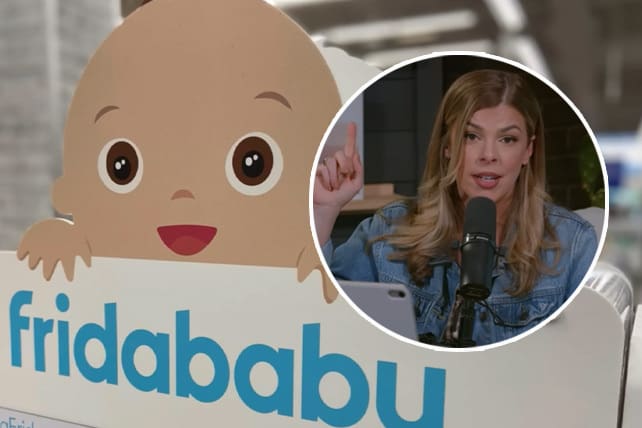
“Really inappropriate,” said Stuckey. “And people kind of dug up who their marketing team was and put—this is on their website—put the names and the faces of these people who are in charge of packaging, who are in charge of marketing, who are in charge of social media.”
“And then Frida Baby ended up taking that page down,” she said. “So, obviously, they realized there’s some controversy there.”
Frida Baby’s Meet the Team page is no longer live, although an archived version of it shows just under 200 employees, approximately 60% of whom are women. “It’s men and women on this team, but it did seem like it was a male team that was in charge of marketing, which I just think is odd,” said Stuckey.
The page begins by listing Chelsea Hirschhorn as Frida’s CEO. The next employees listed are Aaron Camello, package design production manager and Adam Gagliardo, vice president of marketing strategy. “This is obviously a female brand,” Stuckey said. “I’m not saying that you can’t hire men at all, but why would men know what attracts a woman to a particular product? I just find that a little bit weird.”
“And so this is unraveling for them right now,” Stuckey continued. “They have responded and they basically just said, ‘You know what, what’s funny to one person is not funny to another person,’ but they certainly didn’t apologize.”
A statement from Frida Baby responding to the backlash said in part, “From the very beginning, Frida has used humor to talk about the real, raw, and messy parts of parenting that too often go unspoken.”
“Humor is personal,” the statement said. “What’s funny to one parent can feel like too much to another. We’re never trying to offend, push boundaries for shock value, or make anyone uncomfortable.”
“Importantly, our tone is never separate from our product,” said the brand. “The humor we use is always grounded in a specific feature, benefit, or innovation—a reflection of the real problem we are solving for families.”
“How they’re going to pivot, I’m not exactly sure,” Stuckey said. “I just don’t understand when it became acceptable to use kids as fodder for sexual jokes—like publicly, commercially to make money off of something like that.”
She noted that children “can’t speak up for themselves. And there are just perverts out there who love this kind of stuff, and it just ends up infesting people’s brains, and it changes how we talk about children and how we think about this stuff.”
RELATED: Allie Beth Stuckey Raises Concerns About Hyper-Sexualized ‘Wuthering Heights’ Movie