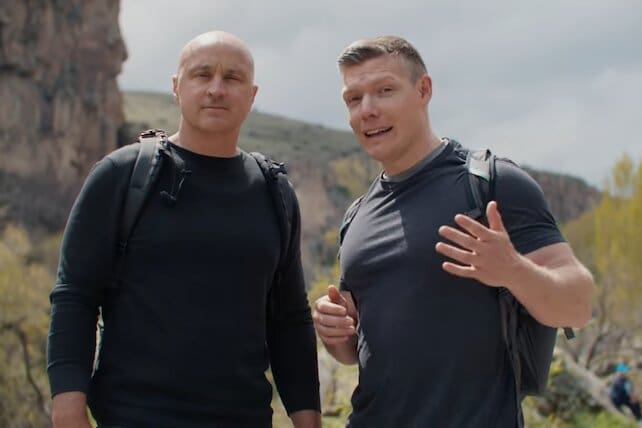
“We have the early Christians talking about the Trinity,” he continued, “maybe not using that exact terminology of ‘Trinity’ or ‘Trinitarian theology,’ but that is what they are talking about. And so the questions at Nicaea are to clarify the language around that, rather than some sort of invention.”
“What we get here is a clarification of orthodoxy—right teaching—of what it means to talk about Jesus as God in relation to the Father and the Spirit,” he said. “That’s the motivation for what actually happens at the Council of Nicaea.”
Steiger and Huff went on to examine other evidence for early Christian belief in Jesus’ divinity, including the Megiddo Mosaic and the Alexamenos Graffito. “As we’ve seen, the Council of Nicaea didn’t invent the Bible; instead it relied upon it,” said Huff. “The council also didn’t invent the divinity of Jesus. Scripture teaches it, the early church proclaimed it, and now archaeology confirms it.”
“The Council of Nicaea is not the conspiracy it’s often made out to be. Stories of secret votes, malevolent emperors, and theologically coercive bishops are just that: stories that have more to do with myth than historic realities,” Huff said. “What ended up being included in the New Testament canon is far more straightforward than one might think. The New Testament books were settled early, with remarkable unity regarding their contents.”
RELATED: ‘We’re Not Saved by Our Works’—Wes Huff Shares the Gospel on ‘The Shawn Ryan Show’
However, he added, “The books prior to the time of Jesus, what we call the Old Testament, and their contents, prove to be more complex.”
Huff and Steiger’s video concluded by explaining how the New Testament actually did come to be, and their next video will apparently explore the complexities behind the forming of the Old Testament canon.
“Understanding the history behind this topic can aid in explaining why Roman Catholic, Greek Orthodox, and Protestant Bibles contain different numbers of Old Testament books,” said Huff.
“To understand why, we’re headed to Italy, to the foothills of the Dolomite Mountains, where a council a thousand years after Nicaea happened,” he said, “a council where controversies, discussions, and votes surrounding what books should be included in the Bible actually did take place.”